
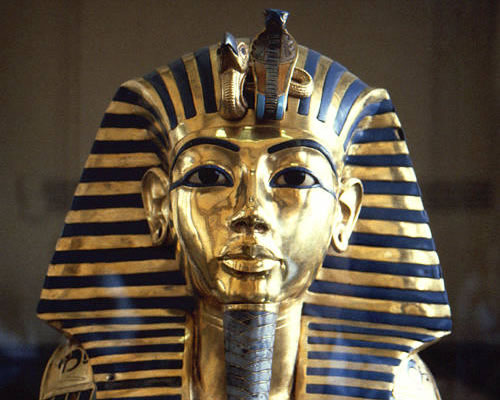
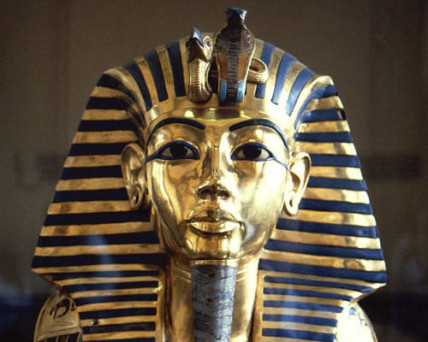
Funeral mask of Tutankhamun. Photograph by Jon Bodsworth
The death of the young Egyptian pharaoh Tutankhamun has mystified researchers since the discovery of his tomb by Howard Carter and George Herbert in 1922. Now, however, the mystery may have been solved.
King Tut died aged 18 or 19 in 1323 BC, nearly 3,000 years ago but British experts using a combination of modern forensic archaeology and with fair amount of luck have finally solved the question of his cause of death – he was injured in a chariot race.
Scientists from the Cranfield Forensic Institute carried out a “virtual autopsy” which revealed a series of injuries to one side of Tutankhamun’s body. These injuries were matched by car crash investigators to a scenario where a chariot smashed into him whilst he was on his knees – the high-speed collision shattering his pelvis, ribs, and obliterating his heart. This damage to his heart also explains why he was the only pharoah mummified without one.
After death, mistakes with his embalming, meant that the mixture of oils, oxygen, and linen spontaneously combusted burning his flesh, and explaining another mystery of the dead king.