

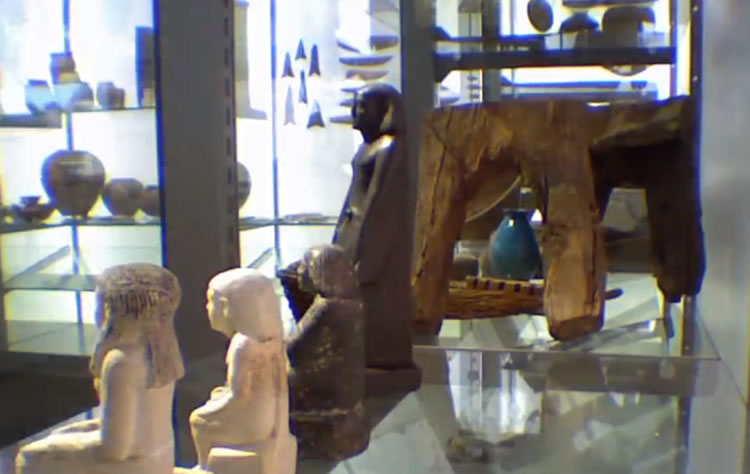
A TV mystery solver claims he has solved the case of an Egyptian statue which baffled researchers and sparked rumours of an ancient curse when it was found to be slowly spinning whilst in a display case in a museum.
A time-lapsed video showed the ancient 4,000 year-old statuette of Neb-Sanu slowly rotating 180 degrees without anyone or anything touching or moving it puzzled staff at Manchester Museum. Adding the the confusion was the fact that the 25cm tall figure would rotate during the day but remain still overnight.
Whilst some thought the rotation was due to an ancient curse for the destroying a mummy’s tomb, others thought that magnetic fields may be at play, and Professor Brian Cox proposed that it was the result of the friction differential between two surfaces.
Now ITV’s Mystery Map programme claims to have found evidence to support Cox’s claim that the serpentine stone of the figure and the glass shelf cause very subtle vibrations resulting in the rotation on the slightly convex base. Mystery Map resident expert Steve Gosling put three-axis vibration sensors under the cabinet, and found that the vibrations peaked with foot-traffic in the museum and cars on the busy Oxford Road nearby, resulting in rotation during the day and not at night when things are quieter.
With the mystery solved, the museum have put a “conservation-grade” membrane between the base of the statuette and the shelf to keep the figure facing the right way in the display case from now on.



2 Comments
I curse you for destroying my tomb! You will face eternal torment by watching my statuette slowly revolving….mwahahaha
Yet again science debunks nonsense…thank God(s) for Atheists, common sense and intelligence and god-damn the religious ;-)