

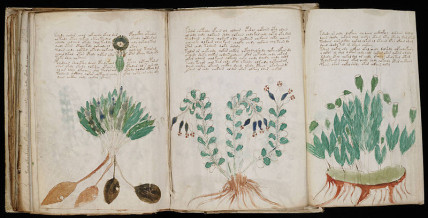
Voynich manuscript
Computer analysis of the fifteenth century Voynich manuscript, considered one of the world’s most mysterious, shows it contains a “secret message”.
The velum book is written in an unknown language or code, and has defied the attempts of code breakers to decipher its message since it surfaced in the seventeenth century. It shows various illustrations of plants, although they show no recorded species, which adds to the mystery.
The manuscript has been dubbed a hoax by a number of detractors over the years, but carbon dating suggests it was written in the late fifteenth century, and recent computer analysis appears to show “patterns” in the text which researchers believe would have been impossible to fake in that period, as well as new keywords which may aid in deciphering its contents.
Other cyphers previously considered impenetrable, such as the eighteenth century Copiale Cipher, have recently been cracked with the aid of computer analysis, and the recent study of the Voynich manuscript may provide enough clues to break its code.
The analysis by Dr. Marcelo A. Montemurro of Manchester University, investigates the text on a large scale looking for “clusters” of words or phrases in more than one place in the text, which could give clues as to keywords, even when the underlying language is unknown. The clusters found by Dr Montemurro in the Voynich manuscript appeart o show patterns similar to known languages, and “matching” the obscure illustrations.
It is impossible to rule out a hoax without diciphering the text, but Dr Montemurro believes his analysis shows that the manuscript is decipherable and needs more attention from the world’s crytographers.