

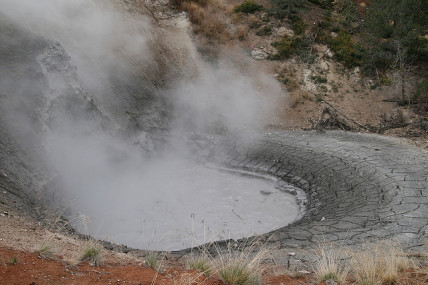
Photograph by Bernt Rostad
Yellowstone National Park in the US houses a supervolcano that scientists now believe is much larger than previously thought.
The findings, presented at the American Geophysical Union Fall Meeting in San Francisco, show that the magma chamber is about 90km in size, 2.5 times bigger than originally thought, and contains 200-600 cubic km of molten lava.
To estimate the size of the cavern, the team of scientists used seismometers situated around the park which measured how the seismic waves from earthquakes travelled through the materials beneath the soil. As the waves travel more slowly through the hot, molten lava the scientists were able to examine the size of the magma chamber.
The last major eruption at yellowstone was 640,000 years ago, and was large enough to affect the climate across the globe as well as sending a cloud of ash across the whole of north America.
Some researchers believe that eruptions on this scale occur about every 6-700,000 years, so one may be overdue, but all agree that an eruption today would be catastrophic.



1 Comment
Can we build a graphene net to put a lid over it?