

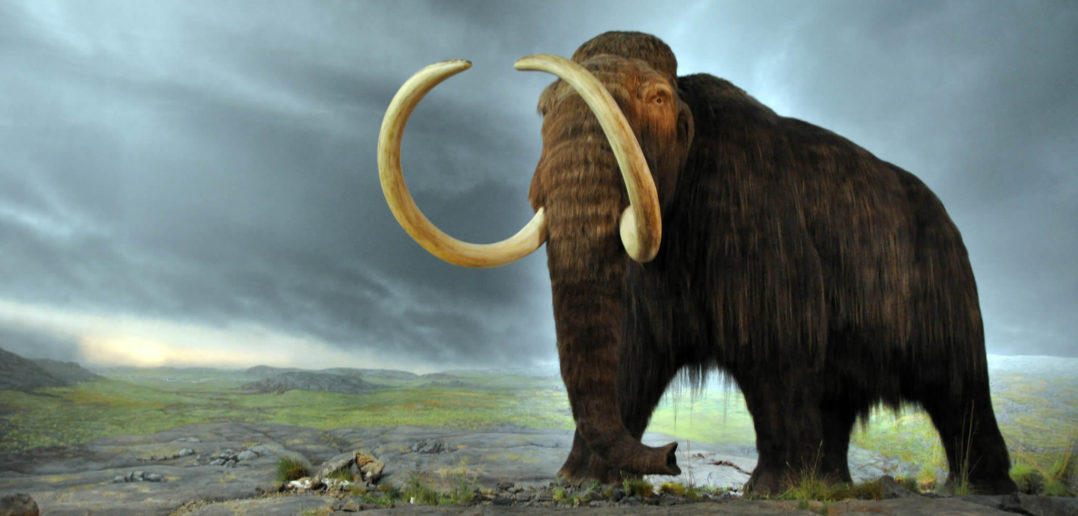
Scientists at Harvard University have successfully managed to inset genes specific to the woolly mammoth into the genome of an Asian elephant, the extinct species closest living relative.
Woolly mammoths (Mammuthus primignius) first appeared during the middle Pleistocene period, around 400,000 years ago, and lived alongside early humans in the Northern Hemisphere as recently as 10,000 years ago.
A small population of mammoths continued to survive on Wrangel Island in the Arctic Ocean until as recently as 3,500 years ago.
Woolly mammoths lived in frozen parts of the world, which means that a number of animals became encased in permafrost after death, which shielded them from predators and decomposition. This has meant that some specimens have been very well preserved for thousands of years. However, DNA degardes over time, and the process of degradation is accelerated by microbes in the water, and researchers have only been able to recover fragments of mammoth DNA.
Currently, scientists have failed to recover sufficient amounts of mammoth DNA to stitch together their entire genome, which would provide the possibility of bringing the species back to life.
Nonetheless, a team of scientists from Harvard University have managed to merge the genes recovered from mammoth specimens with those of the Asian elephant, the species closest living relative.
Lead researcher of the Harvard team, George Church, told the Sunday Times that they have been successful in implanting sections of mammoth DNA into functioning elephant cells, but said there was still much work to be done before there will be a possibility of bringig the extinct animal back to life.
He said:
“We prioritized genes associated with cold resistance including hairiness, ear size, subcutaneous fat and, especially, hemoglobin [the molecule in red blood cells that transports oxygen around the body].
“We now have functioning elephant cells with mammoth DNA in them. We have not published it in a scientific journal because there is more work to do, but we plan to do so.”



1 Comment
Hi,
“Scientists successfully insert woolly mammoth DNA into elephant genome”. If thet did the same with a sheep and a kangaroo they would get a wooly jummper.