
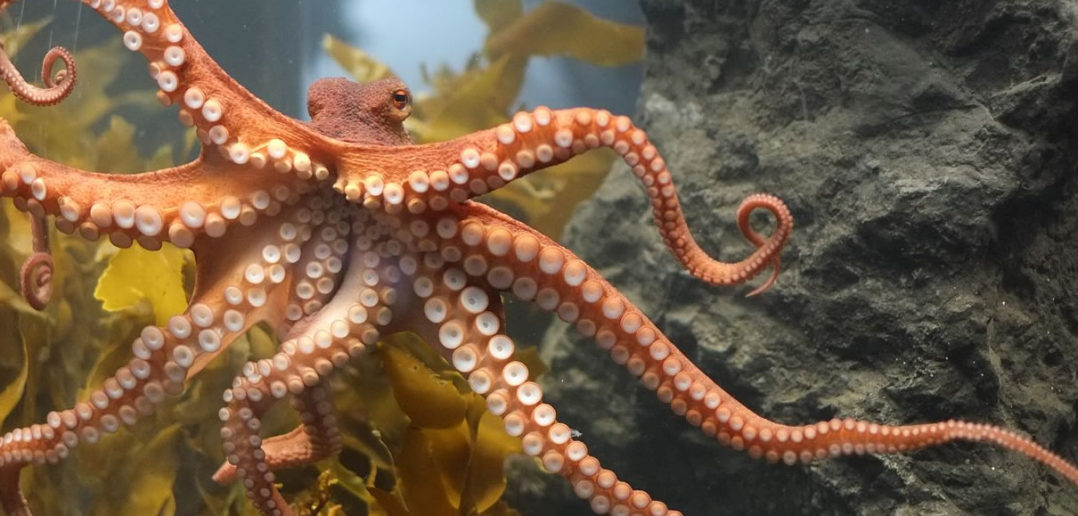
Researchers have solved the mystery of how octopuses, with their two legs and six arms covered in hundreds of suckers, do not stick to themselves.
Humans control their limbs through a “fixed representation of the motor and sensory systems in the brain in a formant of maps that have body part coordinate”, explains Binyamin Hochner of the Hebrew University of Jerusalem. However, as octopuses have long flexible limbs with infinite degrees of freedom, such control is not possible.
Octopuses “lack accurate knowledge about the position of their arms”, and this raises the question of how they prevent their limbs from getting entangled.
The researchers studied behaviour of amputated octopus arms, which stay active for an hour after amputation, and they found that the arms never grabbed onto an octopus arm, but would do so if the skin was removed, which implied that a “specific chemical signal in the skin mediates the inhibition of sucker grabbing”.
Octopuses are able to override this chemical signal when it is opportune for them to grab onto their own limbs, but the basic instinct to avoid attaching to its own limbs could be useful in the development of bioinspired robot design.
The researchers published their findings in the journal Current Biology.