

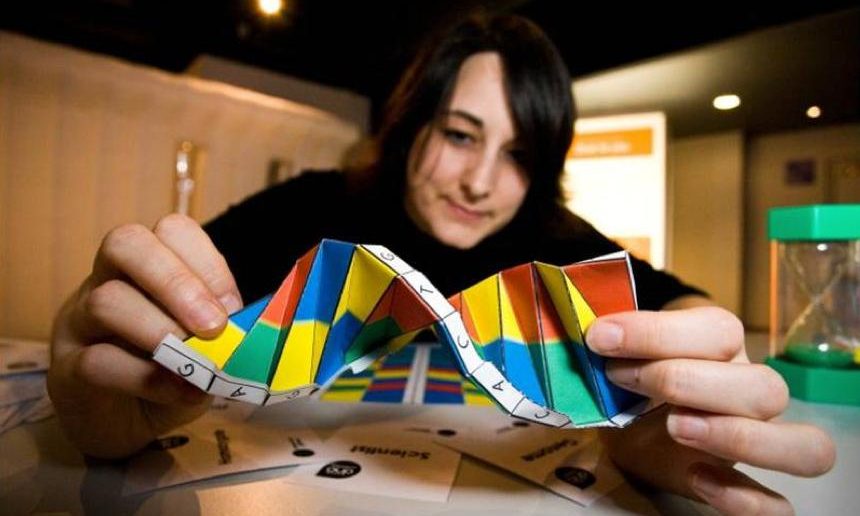
Scientists in California have created a living organism with genetic code comprised of six letters rather than four, the first time a living organism has been made from artificial genetic building blocks.
Organic life is generally built using the nucleotides A, T, C, and G bound together in a double-helix, but researchers at The Scripps Research Institute (TSRI) have successfully added a single X and Y nucleotide pair to the genetic code of an E. Coli bacterium, according to the New York Times.
TSRI Associate Professor Floyd E. Romesberg, who led the research team, said:
“Life on Earth in all its diversity is encoded by only two pairs of DNA bases, A-T and C-G, and what we’ve made is an organism that stably contains those two plus a third, unnatural pair of bases. This shows that other solutions to storing information are possible and, of course, takes us closer to an expanded-DNA biology that will have many exciting applications—from new medicines to new kinds of nanotechnology.”
The scientists have not yet shown whether the new alien bacterium can produce novel proteins with the extra genetic information, and it needs to feed on synthetic molecules to survive so cannot infect other organisms in its current form.
However, by making these changes to the genetic code, the scientists have for the first time created an ‘alien’ life-form, which breaks into new territory for genetic manipulation from an ethical and legal standpoint.



1 Comment
Obviously, biotechnology will produce a new nature, radically different and hardly imaginable nowadays. Even so, will life always be life? Indeed, is the life that is in a cell the same life that is in a monkey or a human being, natural or artificial, foolishly or wisely engineered? And beyond the marvellous specific benefits, what place will the whole of human beings and their traditions have in this new biotech nature? What place those aged societies that do not integrate fully within these biological products? Will biotechnology inevitably produce a new species, will humanity diverge again as the branch of a tree? Is the current production-economic system demanding these changes, its driving-force? Or rather, is the goal to maintain an excellent health of the population? Is the latter credible in a world that is full of competition and enmity? Is it credible when there is hunger in a planet full of protein, where human beings are hungry meanwhile a weed of the field lives without problems? Along these lines, there is a peculiar book, a public preview in http://goo.gl/rfVqw6 Just another suggestion for leisure, far away from dogmas or axioms