
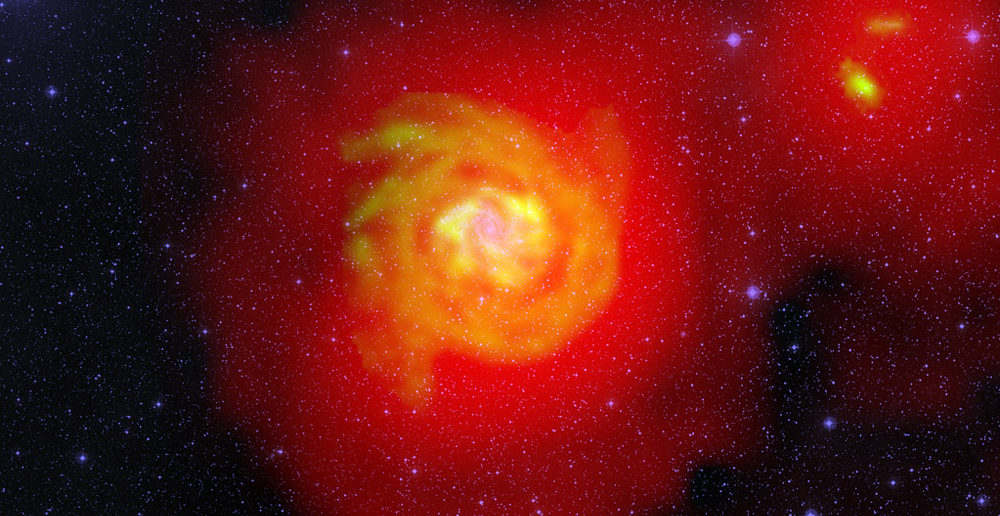
This composite image contains three distinct features: the bright star-filled central region of galaxy NGC 6946 in optical light (blue), the dense hydrogen tracing out the galaxy’s sweeping spiral arms and galactic halo (orange), and the extremely diffuse and extended field of hydrogen engulfing NGC 6946 and its companions (red). Credit: D.J. Pisano (WVU); B. Saxton (NRAO/AUI/NSF); Palomar Observatory – Space Telescope Science Institute 2nd Digital Sky Survey (Caltech); Westerbork Synthesis Radio Telescope
Astronomers using the National Science Foundation’s Robert C. Byrd Green Bank Telescope (GBT) have discovered a “cold flow” of hydrogen streaming through space for the first time.
D.J. Pisano of West Virginia University made the discovery of a faint, very tenuous filament of gas, which is streaming into the nearby galaxy, NGC 6946, a find that may help explain how some spiral galaxies maintain their steady pace of star formation.
Pisano said:
“We knew that the fuel for star formation had to come from somewhere. So far, however, we’ve detected only about 10 percent of what would be necessary to explain what we observe in many galaxies… A leading theory is that rivers of hydrogen – known as cold flows – may be ferrying hydrogen through intergalactic space, clandestinely fueling star formation. But this tenuous hydrogen has been simply too diffuse to detect, until now.”
Astronomers have long theorized that larger galaxies might be syphoning off cold hydrogren from other less-massive galaxies nearby, but this is the first time any such “river” of cold hydrogen has been observed, with the study published in the Astronomical Journal.