
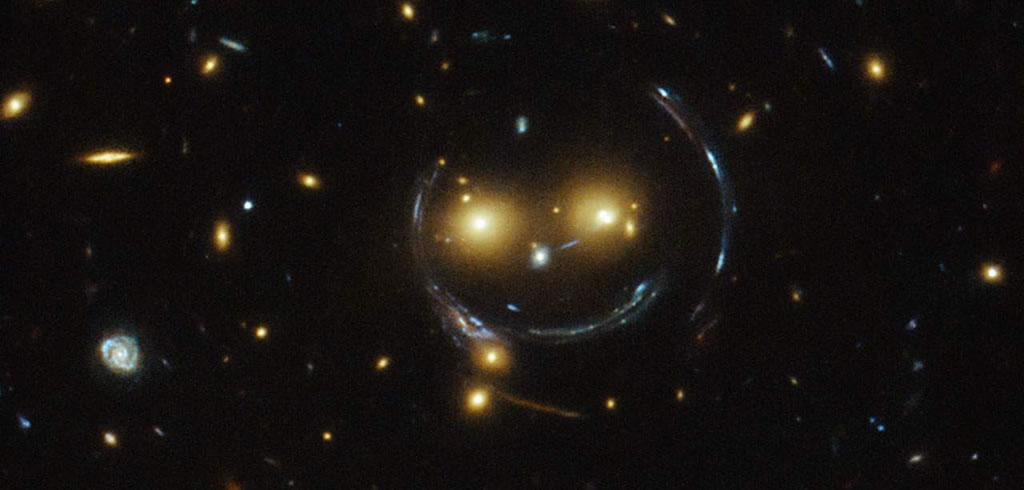
Humans may be predisposed to see faces everywhere we look, but when the Hubble Space Telescope took a recent image of a section of space, there was a distinct smiley face looking back.
The smiling image is of a galaxy cluster called SDSS J1038+4849, and the blurry circular ring that outlines the face is a result of a phenomena called ‘gravitational lensing’.
Gravitational lensing is caused by the massive gravitational forces of a large galaxy cluster distorting light as it travels towards the Earth, creating a circular visual effect that is known as an ‘Einstein Ring’.
The gravity of huge galaxy clusters may the circular outline of the face, but it is a very human phenomenon that makes the Hubble image look like a face.
Pareidolia is a psychological phenomenon where vague or random stimulus, often image or sound, is perceived as significant, and is why we see animal shapes in clouds or the faces of religious figures on burnt pieces of toast.
Carl Sagan hypothesized that this pattern recognition was a survival technique that has become hardwired into the human brain over the course of evolution, as it allow us to recognise human faces in the distance and in poor visibility, when few features can be made out.
This basic recognition, that the brain performs in a fraction of a second not only allows a person to recognise a face, but also the emotional state of that individual. This process would have allowed early humans to identify whether a face in the distance was happy and welcoming or threatening and a threat, giving them time to flee.