

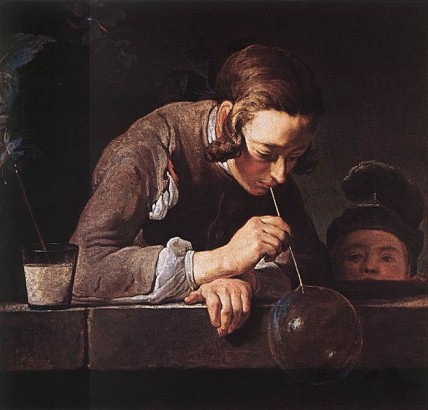
Seifenbläser by Jean-Baptiste Siméon Chardin
Some parents, especially those with writerly or scientific tendencies, cope with the shock of having reproduced by chronicling every twist and turn as their progeny move from mewling rage ball to drooling tyrant, and beyond. Not for the me the introspection and fearless truth telling of Anne Lamott’s Operating Instructions: A Journal of My Son’s First Year, or the abstracted observation of Charles Fernyhough’s A Thousand Days of Wonder: A Scientist’s Chronicle of his Daughter’s Developing Mind. I much prefer to embrace nature’s memory-wiping balm of exhaustion, distraction and confusion.
In short, I’m usually too busy being a parent to have any time or energy left over to write about it. But moments of excess mental capacity do occasionally arise—during the 9th consecutive reading of one of the new, not-so-edgy Curious George stories, say—when the adult brain kicks in. And the writerly, scientific blood begins to boil.
You see, I don’t much mind the cloying, the trite or the repetitive. But children’s literature and song are also riddled with innumerable errors of fact and possibility. I’m not fretting the tall tales or magical this and thats—I’m as happy to have a talking cat with a striped hat as the next guy. But spend enough time listening to kids’ songs and reading their books, and you’re left with just one question: why are these people lying to my child?
Exhibit A: “Ranky Tanky”
“Old lady come from Booster
Had two hens and a rooster
The rooster died, the old lady cried
She couldn’t get eggs like she used to.”
This old folk song was on my son’s first CD, and he fell in love with it. It’s got a good rhythm, a nice rhyming pattern – and a biological untruth so obvious and unapologetic you’d think you were listening to a super PAC attack ad. I’m sure the old lady did indeed regret the demise of her rooster, but it wouldn’t be for the impact on egg production. As anyone who has contemplated backyard agriculture or investigated malfeasance in the egg industry knows, the single coolest thing about laying hens is that they DON’T NEED a rooster to lay eggs. So long as they have at least 14 hours of daylight, and preferably 17 or so, healthy hens will keep on laying, about once every 26 hours. (Having a rooster would lead to fertilized eggs, and if you really want to cry over a rooster, try cracking one of those into your omelet pan after it’s been left out too long.)
Exhibit B: “Slippery Fish”
This one comes with charming hand movements, and starts out properly enough, with an octopus gobbling up the eponymous slippery fish. I’m still on board when the octopus is thence eaten by a tuna and, if we can agree it’s one of the smaller tunas, I have no problem believing that the tuna is subsequently devoured by a great white shark. So why, why, why does the song’s author have to end on an outrageous lie? That great white shark was most certainly not eaten by a big blue whale. The pups are already 5 feet long at birth — about, say, an ORDER OF MAGNITUDE larger than the krill that blue whales prefer almost exclusively. And it makes me cry like the old lady from Booster just to imagine the havoc a thrashing, 20-foot great white could cause to a filter-feeding whale’s delicate sheets of baleen.
Exhibit C: “Water, Water, Everywhere”
The worst crap always comes into your house unexpected, typically stuffed into the bottom of a bag of hand-me-downs by parents who couldn’t find the courage to burn what needs to be burned. This type specimen of towering inanity is no exception. It’s a product of the gawdawful Baby Einstein series, and features a lurid blue octopus (again with the cephalopods!) pointing out all the different places a baby or young toddler might find water. Sprinklers? Check. Oceans? Check. Octopus tears? Well … I’ll let that one go as a stand-in for tears generally, though I trust more than one LWON reader will let us know in the comments whether mollusks really do have lacrimal glands. I’m comfortable assuming not, since tears essentially replicate seawater.
Besides, the real problem is with the following page: “Bubbles blowing, bursting — POP! — A wondrous, wet refrain…” I’m sorry, bubbles? A generation of parents had better hope this isn’t what their children remember should they find themselves stuck in the desert with nothing to drink. Oh sure, there’s a thin layer of stabilized water at the core of any soap bubble film — about aMICRON thick. How many cases of dehydration this hydrologic half-truth may have caused already, I can’t say. But my trust in the written word is irredeemably damaged.
If only, I sometimes think, my full mental capacity were not required simply to outwit an infant into sleeping for longer than 20 minutes with out crying, retching, shitting, or all three at once. I wouldn’t waste my time chronicling the breakthrough — whatever worked this time wouldn’t the next, anyway — but would instead throw myself into writing, and fact checking, my own kid lit, just to save others the pain. Er, you do feel the pain, don’t you?