
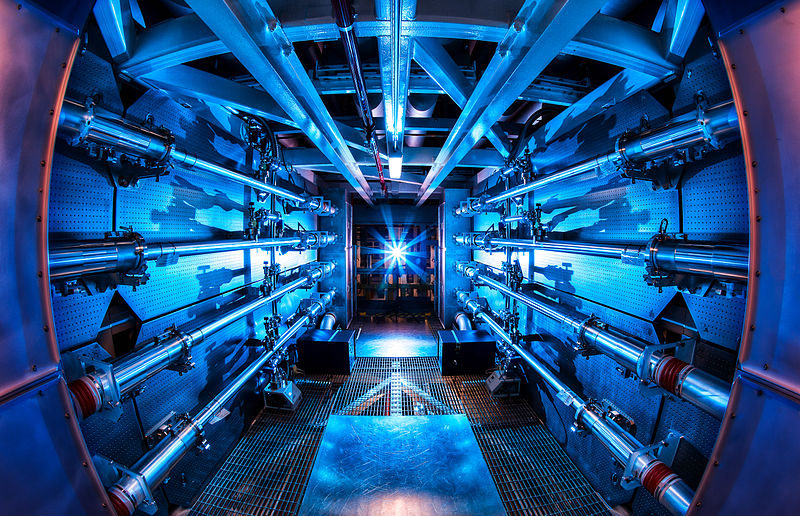
Preamplifiers of the National Ignition Facility Lawrence Livermore National Laboratory
Researchers at the National Ignition Facility (NIF) in California say that they have had a breakthrough in producing nuclear fusion reactions with a giant laser marking a step towards making nuclear fusion energy production a reality.
The researchers managed to produce more energy from the reaction than went into the hydrogen fuel for the first time. This does not mean that the laser used less fuel than was produced, but taht the energy produced in the reaction was less than the energy from the laser focused on the hydrogen fuel, about 1% of the total energy that went into the laser.
The NIF facility consists of 192 laser beams, which can for a brief moment focus 500 trillion watts of power, more than is used across the entire US for the same period, onto a target a few millimetres across according to NPR.
In nuclear fusion, which occurs naturally in our Sun, hydrogen atoms are pushed to fuse together to create helium atoms in an reaction which gives off a lot of energy.
The goal of researchers looking to solve the world’s energy problems is to be able to produce these reactions with using as little input energy as possible, so that the energy given off is greater than that put in, with the news from NIF a first step in that direction.
Construction of NIF began in 1997 and has cost more than $3 billion (£1.8 billion), with the slow progress resulting in many people calling the facility a failure, but news of this breakthrough shows that progress is definitely being made. The new technique, of which the results were published this week from tests back in October 2013, cannot quite reach “ignition” where the energy given off by the reaction is sufficiently high and focused to start a chain reaction, but is still a major breakthrough in the push towards that goal.