
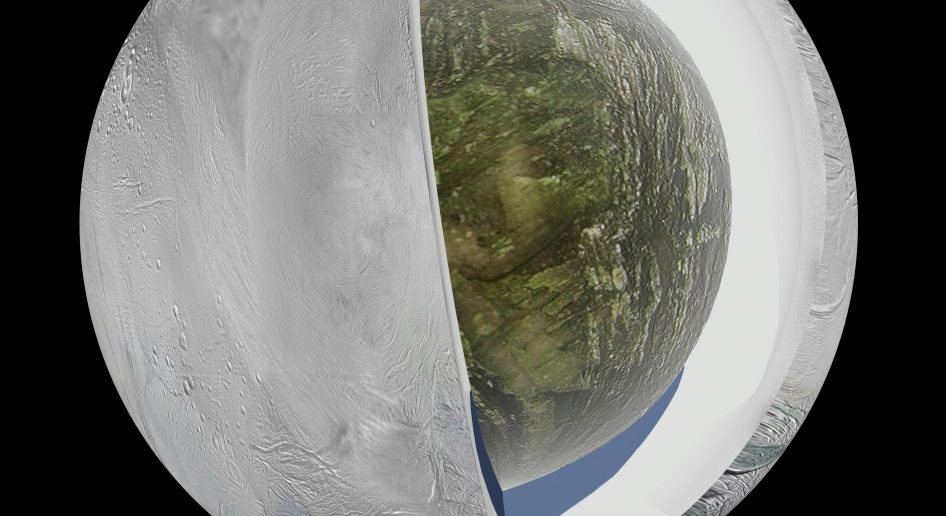
NASA’s Cassini spacecraft and Deep Space Network have detected evidence that Saturn’s moon Enceladus harbours a large underground ocean, furthering speculation that the moon may be a home to extraterrestrial microbial life.
Scientists theorised about the presence of liquid water trapped beneath the surface after Cassini discovered water vapour and ice spewing from vents near the moon’s south pole in 2005.
In a report published in the journal Science, new gravity measurements suggest that a large, 6km deep ocean of liquid water is buried beneath the 30-40km deep ice that makes up the surface of Enceladus.
Sami Asmar of NASA’s Jet Propulsion Laboratory (JPL), a co-author of the paper said:
“The way we deduce gravity variations is a concept in physics called the Doppler Effect, the same principle used with a speed-measuring radar gun. As the spacecraft flies by Enceladus, its velocity is perturbed by an amount that depends on variations in the gravity field that we’re trying to measure. We see the change in velocity as a change in radio frequency, received at our ground stations here all the way across the solar system.”
Luciano Iess of Sapienza University of Rome, the paper’s lead author said:
“The Cassini gravity measurements show a negative gravity anomaly at the south pole that however is not as large as expected from the deep depression detected by the onboard camera. Hence the conclusion that there must be a denser material at depth that compensates the missing mass: very likely liquid water, which is seven percent denser than ice. The magnitude of the anomaly gave us the size of the water reservoir.
”