
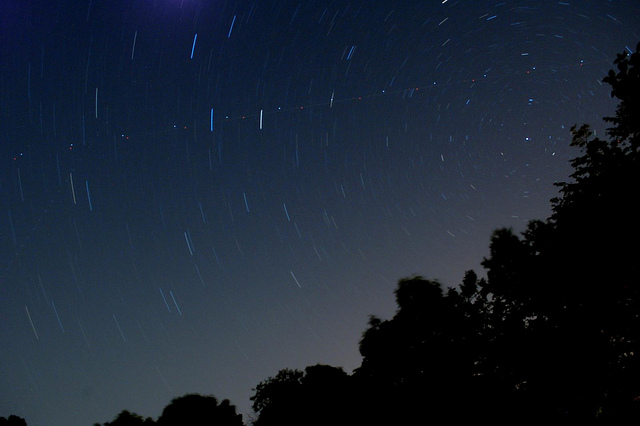
Extra-long exposure of the night stars. Photograph by Guy Dickinson
A new “super-Earth” planet has been discovered that may have an earth-like climate that could support life has been discovered orbiting a nearby star by an international team of astronomers, led by Mikko Tuomi, University of Hertfordshire, and Guillem Anglada-Escude, University of Goettingen.
The planet exists in the habitable “Goldilocks Zone” of a nearby star and is part of a six-planet system. This system was previously thought to have contained just three planets, all existing too close to the sun to support liquid water, but using new techniques to avoid fake signals caused by stellar activity, the researchers were able to identify three new super-Earth planet candidates also in orbit.
Mikko Tuomi said: “We pioneered new data analysis techniques including the use of the wavelength as a filter to reduce the influence of activity on the signal from this star. This significantly increased our sensitivity and enabled us to reveal three new super-Earth planets around the star known as HD 40307, making it into a six-planet system.”
Of the three newly discovered planets, it is the one orbiting furthest from the star with a mass greater than seven times that of the earth that is of the greatest interest to researchers as its orbit around its star is at a similar distance to that of earth to our sun. At this distance, there is a greater chance of liquid water and a stable atmosphere, as well as the possibility that the planet rotates on its own axis whilst orbiting its star creating a more “Earth-like” environment.
Guillem Angla-Escude said: “The star HD 40307, is a perfectly quiet old dwarf star, so there is no reason why such a planet could not sustain an Earth-like climate.”
Earlier this year, the Kepler spacecraft found a planet with a similar orbit. However, Kepler 22d is located 600 light years from Earth, whereas this new super-Earth planet known as HD 40307g is much closer being located at 42 light years from Earth.
Mikko Tuomi carried out this work as a member of the European science network RoPACS (Rocky Planets Around Cool Stars) — an initiative with a research focus on the search for planets around cool stars. RoPACS has pan-European membership and is led from the University of Hertfordshire by David Pinfield, who commented: “Discoveries like this are really exciting, and such systems will be natural targets for the next generation of large telescopes, both on the ground and in space.”
Citations:
Mikko Tuomi, Guillem Anglada-Escude, Enrico Gerlach, Hugh R. A. Jones, Ansgar Reiners, Eugenio J. Rivera, Steven S. Vogt and R. Paul Butler. Habitable-zone super-Earth candidate in a six-planet system around the K2.5V star HD 40307. Astronomy & Astrophysics, 2012; (accepted for publication)