
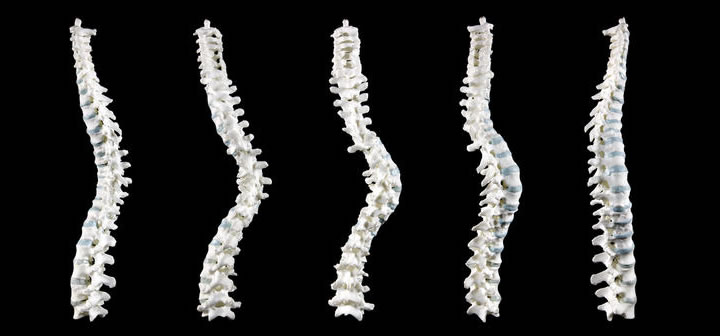
In popular culture, Richard III is imagined as a hunchback since Shakespeare described him that way in his play, but a new three dimensional model of his spine shows that it was spiralled and he suffered from adolescent idiopathic scoliosis.
Archaeologists dramatically discovered Richard III’s bones under a city council car park in Leicester in 2012, and confirmed his identity with DNA tests.
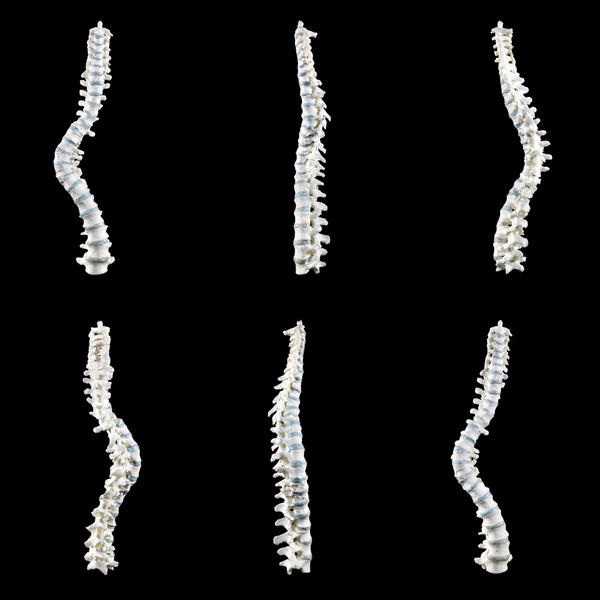
Now researchers led by University of Leicester bioarchaeologist Jo Appleby have studied his remains to determine whether the stories of his hunchback were true. They conducted computed tomography scans of the king’s individual vertebrae, and then made polymer copies of each one and pieced them back together to form a direct copy of the King’s spine, with their findings published in The Lancet.
Dr Jo Appleby said:
They found that Richard III had severe scoliosis, with a particularly pronounced right-sided curve and a spiral nature to his spine. His right shoulder would have been higher than his left, and his torso would have been relatively short compared to his arms and legs, but he had a “well-balanced curve” and his head and neck would have been straight.“The major finding we have made is being able to reconstruct the three-dimensional nature of the scoliosis and understand what it would have looked like.
“Obviously, the skeleton was flattened out when it was in the ground. We had a good idea of the sideways aspect of the curve, but we didn’t know the precise nature of the spiral aspect of the condition.”
Appleby said:
“Although the scoliosis looks dramatic, it probably did not cause a major physical deformity. This is because he had a well-balanced curve. The condition would have meant that his trunk was short in comparison to the length of his limbs, and his right shoulder would have been slightly higher than the left, but this could have been disguised by custom-made armour and by having a good tailor.”
Richard III ruled England from 1483 until he died in the Battle of Bosworth in 1485. Shakespeare portayed him as a “poisonous bunch-backed toad” in his play named after the King written around 1492, but in 1490 medieval historian John Rous had more accurately described him as a small man with “unequal shoulders, the right higher and the left lower”.