
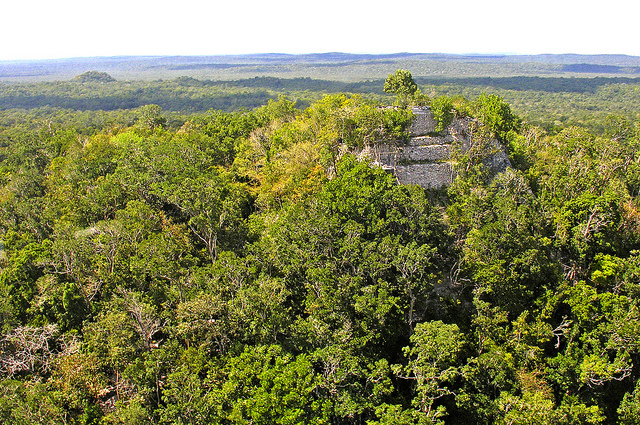
Aerial photograph of Maya site at El Mirador. Photograph by Dennis Jarvis
Archaeologists claim to have found an ancient Maya city that has been lost to civilisation for centuries in the jungles of eastern Mexico.
The discovery was made in a remote nature reserve by a team of archaeologists led by Ivan Sprajc, associate professor at the Slovenian Academy of Sciences and Arts, with the group uncovering 15 Maya pyramids, including one 23m tall.
They believe that the city, which they have named Chactun, could have been home to 40,000 people during 600 and 900 AD, making it the second largest Maya city after Tikal in Guatemala. The site covers 54 acres, with the whole site covered in thick jungle which has helped keep the site unknown to the academic community, although cuts in nearby trees show that lumberjacks and gum extractors have known of the site for decades.
Sprajc and his team discovered the potential site form reviewing aerial photographs taken by the National Commission for the Knowledge and Use of Biodiversity 15 years ago and then spending three weeks cutting a path to the remote site, but what they found could have been from Indiana Jones.
The team hopes to discover what caused the city to be abandoned and how the how the relationships worked between the neighbouring cities at the time.
Their research was approved by the Mexican National Institute of Anthropology and History and funded by the National Geographic Society and two European companies.