

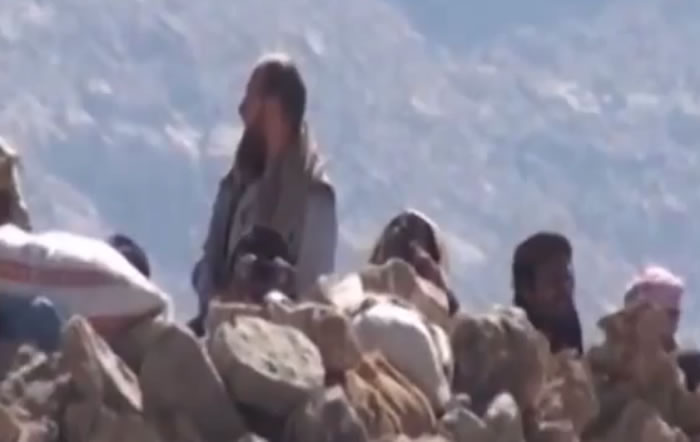
Yemen’s Zayidi Huthi movement, also known as Ansar Allah, and their Sunni Salafi neighbors in Dammaj at the Dar Al-Hadith Academy might again be on the doorstep of war, a development that could have serious consequences for Yemen’s future. The latest round of the feud began nearly a month ago when Salafis at the Dar Al-Hadith Academy reported that Huthi forces were encroaching on Dammaj’s perimeter by building barricades and digging trenches on nearby mountains. This prompted the Salafis’ sympathizers across the Yemeni online landscape to condemn the Huthis’ actions as a violation of the truce agreement the two sides signed in 2012 following a bloody Huthi siege of Dammaj that lasted for months.
Then, beginning on July 14th, after several weeks of silence from the Huthi movement, the group’s official Facebook and YouTube accounts issued four videos allegedly demonstrating that the Salafis have foreigners within their ranks and that the Salafis are preparing for war against the Huthis by constructing military outposts near Dammaj. Meanwhile, the pro-Huthi satellite television station, Al-Masirah, reported that Yemeni military members were spotted training the Salafis’ for war.
In response to the perceived Huthi aggression, comprising of both on-the-ground military actions and online counter-messaging, the Salafis also announced last week that an “emergency” meeting would be held in Sana’a on Monday, July 22nd with Salafi supporters from across Yemen to discuss how they can support their brethren at Dar Al-Hadith in Dammaj. Indeed, Yemeni media reported on Monday that Salafi supporters are out in force securing the Sana’a neighborhood of Sawan near the Al-Sunnah mosque. This comes after a period of rising tensions between the two sides’ supporters in Yemen’s capital city after Huthi supporters took over a mosque led by a Sunni imam and then Sunni Salafis attempted to do the same at a Zayidi mosque.
The sectarian conflict that could result from the past month’s escalations would come at a terrible time for this post-Arab revolution nation whose interim government is working hard to bring its disparate political forces together through a National Dialogue Conference (NDC) in the hopes of eventually writing a new constitution and addressing Yemen’s persistent political and economic problems. The Huthi movement, which previously fought six wars with the government from 2004 through 2010, is a key participant in the NDC, and any distractions would work against the fragile state’s ability to transition to a new constitution and democratically elected government by 2014.
There are already indications that the Huthis want to make their conflict with the Salafis an issue at the NDC. On Monday, pro-Huthi representative Ahmad Sharaf Al-Din used part of his speaking time to advocate for the moving of the Dar Al-Hadith Academy away from the Huthi stronghold of Sad’ah to the capital city Sana’a on account of the alleged threat it poses to the region.
Meanwhile, Saudi Arabia and Iran both have skin in the game. The cross-border violence that drew Saudi armed forces into the last of the Huthi wars in 2010 is still fresh on their minds. Moreover, with Iran and Saudi currently supporting opposing sides in Syria, there may be a greater imperative than ever for each to bring the heat to the other in Yemen—Iran backing the Huthis and Saudi backing the Salafis in Dammaj.
The conflict is part of a recent but intense divide in theology and political thought in Yemen’s restive northwest region. While the Salafis fall within the general category of Sunni Islam, the Huthis are a modern political movement founded by Shiites of the Zayidi school of thought. The historical division between the two sides is complex. The Salafi Dar Al-Hadith Academy was founded in Sa’dah province in the early 1980s by an Islamic scholar named Muqbil Al-Wad’i who returned to his native Yemen after a short imprisonment in Saudi Arabia following his suspected involvement in the Grand Mosque Seizure. Meanwhile, a Zayidi revivalist movement named the Believing Youth was fostered by members of the Al-Huthi family in Sa’dah, where the vast majority of inhabitants are Zayidi. Over time, the Believing Youth came to be known as the Huthi movement.
As both the Dar Al-Hadith Academy and the Huthi movement matured, it became clear that their divisions run deep. The Huthis, on one hand, are an overtly political and militant group that sees in Salafi Islam in Sa’dah province as an existential threat emanating from the perception that Salafis label all minority Muslim sects to be infidels. On the other hand, the Salafis are hyper-sensitive to deviations from the doctrine of the early Muslims, and view the Huthis’ alleged Iranian connections as evidence that the Huthis are of the most deviant of Muslims. Additionally, the Salafis in Dammaj are of the quietist persuasion in their politics, viewing rebellion against a Muslim ruler, such as the Huthis’ six previous wars against the government, to be deeply antithetical to Islam.
Written by Tony Busch
Tony Busch holds an Arabic language certificate from the University of Damascus in Syria and has nearly four years of experience performing online social network analysis.



1 Comment
May Allah aid the salafi’s in Dammaj and destroy the houthies!! Aameen.