
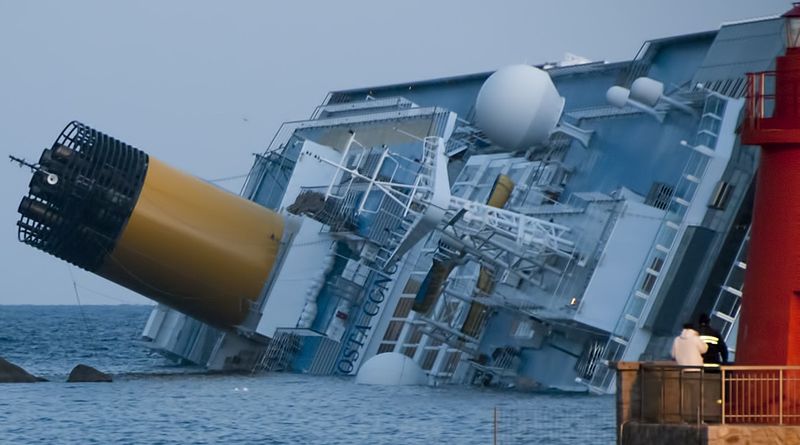
Shipwreck of the Costa Concordia. Photograph by Roberto Vongher
After delays due to bad weather, the salvage operation to drag the wreck of the cruise ship Costa Concordia upright has begun.
The operation began at 09:00 local time (07:00 GMT) and is expected to take around 12 hours, three hours late after a storm overnight prevented a barge carrying a remote control room from getting into position.
The Costa Concordia ran aground off the Tuscan island of Giglio on January 13th 2012, killing 32 people. Five people involved in the wreckage have been convicted of manslaughter, and the ship’s captain, Francesco Schettino, is currently facing charges of manslaughter and abandoning ship.
The bodies of two of those killed have never been recovered and may be discovered during the salvage operation.
To pull the ship upright, giant metal cables have been attached to each side, with giant metal containers, called caissons, also attached. The caissons on the side of the ship above water are filled with water so gravity can help to pull that side of the ship downwards, whilst the cables attached on the other side beneath the water keep the ship steady. This whole process is called “parbuckling”.
The ship will be rolled until it is sitting upright upon a specially created steel and concrete frame built beneath the water.Once the ship is upright, the caissons holding water are emptied, with the empty containers on each side giving the ship buoyancy to lift form the metal frame so it can be towed. Next year in late spring or summer, the Costa Concordia will then be towed away from the island to be taken to an Italian port, such as Piombino or Palermo, where it with be dismantled for scrap.