
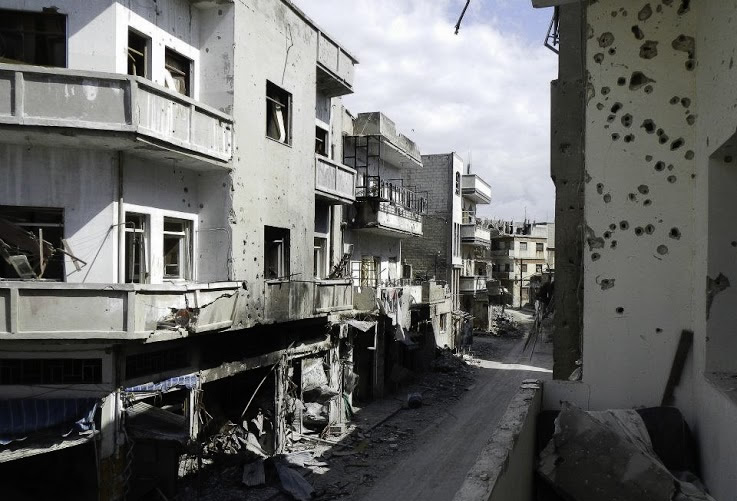
Destruction in Homs, Syria. Photograph courtesy of Freedom House
It is a common misconception that the International Criminal Court (ICC) is able to intervene in Syria and prosecute either side of the conflict for crimes against humanity. This article outlines why the ICC is not able to intervene right now and hold either side accountable for the Syrian conflict.
The gravity of the civil war in Syria can be compared with other major conflicts in the world such as the one between government forces and the LRA in Uganda (Kony), or the situation in Sudan. It is no surprise that many cannot comprehend why the International Criminal Court, which was created to ensure justice to victims of genocide and mass violations of human rights, is unable to do much but watch helplessly.
To understand why the ICC has no jurisdiction in Syria and is therefore unable to prosecute members of either side committing serious crimes, the foundation of the ICC has to be highlighted. The Rome Statute of the International Criminal Court, short Rome Statue, has been created in the framework of a diplomatic conference in Rome in 1998 and came into force in 2002.
Since 2002, 122 states have signed and ratified the Rome Statute, while 31, among them Russia, have signed but not ratified the treaty. 41 UN member states have not signed the Rome Statute, among them is also Syria. This is important when answering the question why the ICC cannot prosecute perpetrators of violence in Syria.
The ICC has four mechanisms for starting an investigation in a country. 1) The person under review is a national of a State that signed up to the Rome Statute, 2) the crime to be investigated took place on the territory of a member state to the Rome Statute, 3) the UN Security Council refers a situation to the ICC, 4) the State itself accepts that the Court has jurisdiction in its territory.
At the moment there are eight cases at the ICC. In four of them, the local government has called on the ICC to start its investigations. These are Uganda (the Prosecutor v. Joseph Kony, Vincent Otti, Okot Odhiambo and Dominic Ongwen), Democratic Republic of Congo (the Prosecutor v. Thomas Lubanga Dyilo; The Prosecutor v. Bosco Ntaganda; The Prosecutor v. Germain Katanga; The Prosecutor v. Mathieu Ngudjolo Chui; The Prosecutor v. Callixte Mbarushimana; and The Prosecutor v. Sylvestre Mudacumura), Central African Republic (The Prosecutor v. Jean-Pierre Bemba Gombo) and Mali (investigation still open).
Two cases, Libya and Sudan, have been referred to the ICC by the UN Security Council. In Libya, Saif Al-Islam Gaddafi and Abdullah Al-Senussi are to face the judges, while there are five cases in Darfur, Sudan (the Prosecutor v. Ahmad Muhammad Harun (”Ahmad Harun”) and Ali Muhammad Ali Abd-Al-Rahman (“Ali Kushayb”); The Prosecutor v. Omar Hassan Ahmad Al Bashir; The Prosecutor v. Bahar Idriss Abu Garda; The Prosecutor v. Abdallah Banda Abakaer Nourain and Saleh Mohammed Jerbo Jamus; and The Prosecutor v. Abdel Raheem Muhammad Hussein).
In the last two cases in Côte d’Ivoire (the Prosecutor v. Laurent Gbagbo) and Kenya (the Prosecutor v. William Samoei Ruto and Joshua Arap Sang; The Prosecutor v. Uhuru Muigai Kenyatta), it was the prosecutor who opened investigations proprio motu, meaning a prosecutor of the ICC can initiate investigations without the referrel of the UNSC or the State. However, the ICC were later formally invited by Côte d’Ivoire, while Kenya seems keen on using political pressure to avoid a prosecution of its political figures accused of increasing post-election violence.
In the case of Syria, all these mechanisms mentioned above in actual cases cannot give the ICC jurisdiction over the crimes committed in the country. Syria is not a state party to the Rome Statute, therefore the ICC has no jurisdiction in that region. If this is to change then Syria should either become a signatory of the Rome Statute or somehow ensure that it gets the UNSC referral it desperately needs unless members Russia and China choose to veto the resolution.
The victims of the civil war in Syria will therefore not receive any justice through the ICC and the UN Security Council has yet to reach a conclusion on which side to support or how to best end this conflict. If this conflict cannot be resolved by international bodies then Syria must strive to stop the fighting alone. The question is how.
Written by Stephanie Rutz