
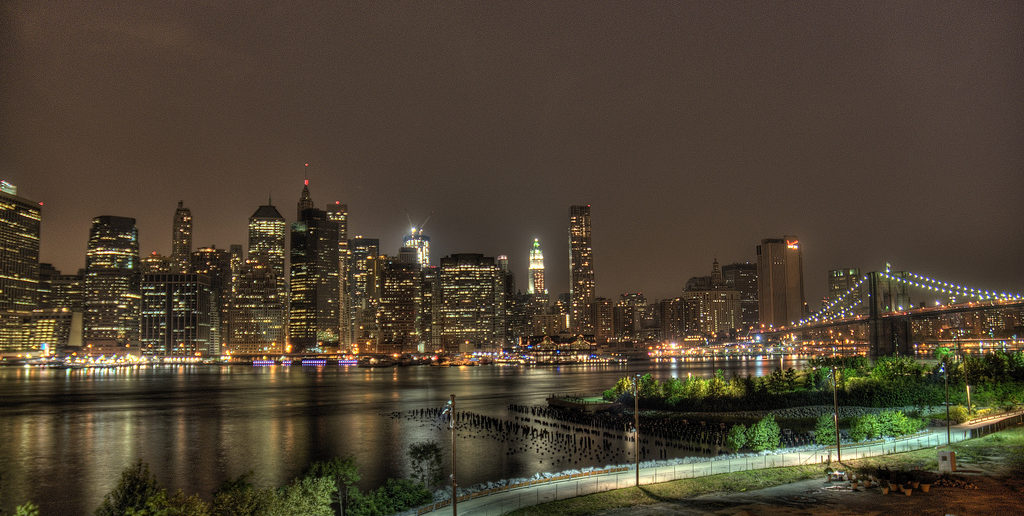
Photograph by Kim Carpenter
“It was the best of times, it was the worst of times.” The classic Dickens line from A Tale of Two Cities could arguably apply to New York today. After 12 years under the guidance of Mayor and business mogul Michael Bloomberg, the biggest city in the United States is itself a tale of two cities. On the one hand, New York is more gentrified and safer than ever as previous no-go areas in Brooklyn and Harlem have been transformed into playgrounds for students and young professionals. On the other hand, skyrocketing housing prices and the 2008 financial meltdown has sent more of the city’s poor to the streets than ever before.
From a statistical point of view, New York looks more like a developing city than the capital of the developed world. The economic recovery has been uneven on the micro level; the wealthiest of the city’s inhabitants have largely bounced back from the 2008 crisis while the amount of the city’s 8 million inhabitants living in poverty has increased. According to the 2013 Credit Suisse Global Wealth Databook, the richest 10% of the U.S. population own 75.4% of the country’s wealth, a higher percentage than in any other developed nation (the U.K. wealth concentration percentage stands at 53.3%). Within the United States, no other city hosts a wider gap between the ‘haves’ and ‘have-nots’ than New York, with one per cent of New Yorkers earning 35% of the city’s income. New York is currently the most unequal city in the most unequal state in the most unequal country in the developed world.
It is the statistics on poverty in New York that are most shocking, however. In 2012, the number of New Yorkers living in poverty rose to 21.2%. Beyond those officially below the poverty line, 46% of New Yorkers make less than 150% of the poverty threshold, a special benchmark used for describing those who live above the poverty line but struggle to get by due to the city’s high living costs. Indeed, rent prices have risen to dizzying heights across New York’s five boroughs as a wave of gentrification has swept over the city alongside rezoning projects implemented by Mayor Bloomberg. The process has turned many of the city’s previously no-go areas into desirable neighbourhoods for the well off but has also made life harder for many long-time residents of Brooklyn or Harlem.
Dasani’s story
A recent five-part, 29,000-word ‘interactive’ article in the New York Times has re-launched a fierce debate on gentrification and the levels of poverty and inequality in New York. The story, entitled ‘Invisible Child’, recounts the life and times of a 12-year old girl named Dasani who, along with her parents and seven brothers and sisters, lives in a Brooklyn homeless shelter. The author, Andrea Elliot, shadowed Dasani and her family for 15 months documenting every aspect of their onerous lives, from the single room they share in a decrepit building to the addictions of the parents to the daily humiliation Dasani experiences at school for coming from “the projects”.
Present throughout the entire piece is the juxtaposition between the extreme poverty in which Dasani lives and the new economy that has sprung up to cater to super-rich Brooklyn implants. Particularly in the story’s third chapter, entitled ‘A Neighborhood’s Profound Divide’, Elliot remarks, “On the Brooklyn block that is Dasani’s dominion, shoppers can buy a $3 malt liquor in an airless deli where food stamps are traded for cigarettes. Or they can cross the street for a $740 bottle of chardonnay at an industrial wine shop accented with modern art.” The old and new Brooklyn exist simultaneously, if not side by side than with the new superimposed over the old, hiding the city’s misery with the glossy shine of gentrification.
The article is overtly critical of Mayor Bloomberg’s policies, which are said to have aggravated the problems faced by the city’s poor. The Mayor’s opponents regularly accuse the billionaire Republican-turned-Independent of catering to the rich while ignoring the less fortunate. In a country where meritocratic ideals and the importance of personal responsibility often carry more weight than the welfare state, however, the article has its fare share of detractors.
In a typically blunt New York Post editorial entitled ‘The New York Times’ homeless hooey’, the authors point out that much of the blame for Dasani’s situation lies at home with her parents who consistently misspend welfare payments and make little to no effort in seeking employment. Indeed, since 2000, the city has spent nearly a half a million dollars on Dasani’s family, money that seems to have evaporated given their living conditions. Another writer, Nicole Gelinas, argues that, far from ignoring the poor, Bloomberg’s generosity is unprecedented. The city currently spends $981 million on the homeless, compared to the $497 million before Bloomberg took office.
What is clear, however, is that many New Yorkers feel left behind by their city’s government. Mayor-elect Bill de Blasio campaigned on the idea that New York under Bloomberg had become a “tale of two cities” and responded to the Dasani story in a press conference, stating, “If you ever needed an illustration of what the tale of two cities is all about, there you have it. We are simply not going to allow this kind of reality to continue.” A central and ambitious promise of de Blasio’s is to cut homelessness by two-thirds by the end of his tenure. Nevertheless, while his successful election campaign clearly seems to give the new Mayor a mandate to pursue such goals, it remains to be seen if New York taxpayers can stomach the costs.