
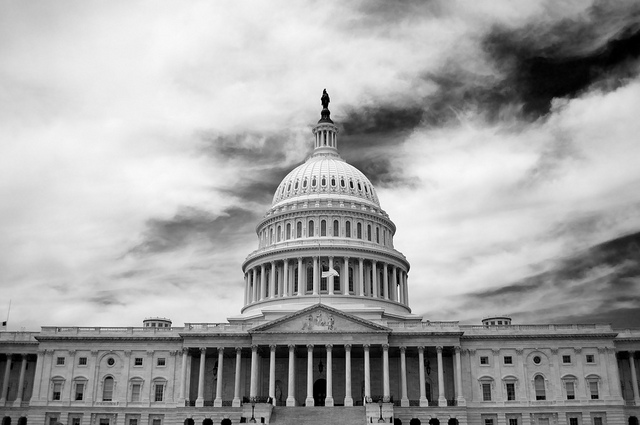
Photograph by bclinesmith
The failure of the United States government to pass a budget has resulted in the suspension of all but “essential” state services and is leading many to express their frustration with the entire political class. This time, though, it shouldn’t.
In five years of dithering on the edge of government shutdown in budget debates, the US Congress had always passed a last-minute measure to push the problem a bit further down the road. This time though, the red line has been crossed and the government has officially been ‘shut down’.
More accurately, the current state of the government should be called a ‘slow down’. Government services deemed essential, schools, the postal service, drones, are still running along and life for many Americans will not be noticeably different, at least not at first. For many government workers, however, the effects are immediate. More than 800,000 federal employees have been suspended without pay, or ‘furloughed’ and many military personnel, despite being among those who will continue to be paid, have been grounded in Afghanistan and cannot return home to their families until the situation in Washington is resolved.
Economically speaking, the shutdown is expected to cost the United States $300 million each day and will likely curb growth as markets hesitate to continue normal operations as long as political instability in the capital reigns. The real danger, though, is that Congress remains blocked up until October 17th, when the next vote on raising the national debt ceiling will take place. A failure to extend the United States’ federal borrowing limits would result in the country’s first debt default, a development that would almost certainly result in an economic relapse both nationally and internationally.
How did we end up here?
As any casual reader of these developments knows, the current government shutdown is bound up with the Affordable Care Act (ACA), also known as ‘Obamacare’. The vast majority of Republican congressmen vehemently opposes the legislation, which requires all American citizens to purchase healthcare and provides financial aid to those who cannot. The 2012 Presidential election was largely viewed as a referendum on Obamacare, with Republican challenger Mitt Romney campaigning against the ACA every step of the way.
One would think that, because President Obama was elected on a platform that included Obamacare, Republicans would respond in a democratic manner and respect the wishes of the majority of Americans. However, a minority of Republican representatives closely affiliated with the anti-government Tea Party has continued to wage war against the ACA regardless of last year’s election results. For these crusaders, opposing Obamacare is a principled fight against tyranny, against the state forcing its citizens to purchase healthcare.
An unofficial leader of this breakaway party has emerged in the form of Texas Senator Ted Cruz, who successfully ranted against Obamacare for a total of 21 hours on the floor of the US Senate. Gems of his speech included comparing the fight to defund Obamacare to both battling Nazi Germany in the 1940s and the Bataan Death March, in which 10,000 Filipino and American soldiers died at the hands of the Japanese during World War II. Now, Ted Cruz and company are refusing to hold a vote approving the budget for the coming fiscal year unless this ‘Continuing Resolution’ (CR) defunds the ACA.
A broken system?
The government shutdown has led many to dismiss Congress, as well as the entire political system, as ‘broken’ or ‘corrupt’. According to a Pew Research poll, nearly the same amount of respondents blame President Obama (36%) as those that blame the Republicans (39%), and many respondents blame both parties equally (17%). Frustration is rife with American democracy and its apparent inability to get anything done. However, there are several reasons that equating Tea Party Republicans with Congressmen is, in this particular case, unfair.
First of all, most congressmen are in fact willing to work together and compromise. A good deal of Republicans both in the House and the Senate were against shutting down the government over Obamacare. If the House of Representatives (the lower house of Congress) were allowed to hold an open vote on a ‘clean CR’, a resolution that does not propose the defunding of Obamacare, it would “pass with a strong bipartisan vote”, according to Pennsylvania Republican Charlie Dent. The problem is not that no representatives will compromise but that a minority of arch-conservatives, well aware they won’t win any victory democratically, is holding the government hostage.
In the end, viewing the government shutdown and declaring that all politicians are horribly corrupt is exactly what the Tea Party wants, seizing onto popular frustration with political elites in order to implement their own extreme neoliberal policies. While it may be exaggerated to judge that the entire American political system broken, however, one must admit that any system that allows a minority of wing-nuts to bring the government to a standstill is at least in need of some fixing.