
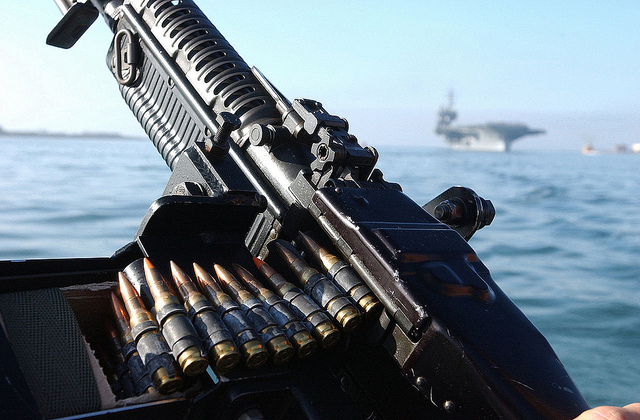
Photograph by Greg Bishop
The UN General Assembly has adopted a historic treaty to control the trade in conventional arms and weaponry, voting it through by a huge majority. 154 member-states voted in support of the treaty, with 23 abstentions, and three votes against.
Commenting on the treaty, Foreign Secretary William Hague said:
This is an historic day and a major achievement for the United Nations. The world at last has a robust and legally-binding Arms Trade Treaty…This Treaty will save lives and make the world a safer place.
The conventional arms trade is estimated to be worth £46 billion annually, and this treaty prohibits states from exporting weapons for use in acts of genocide, crimes against humanity, war crimes, terrorism, or in violation of arms embargoes. It also requires states to prevent such weapons reaching the black market, where arms could then be sold on in violation of the treaty.
The treaty went to a vote after Syria, Iran, and North Korea blocked its adoption by consensus.
Russia, the world’s second biggest arms exporter behind America, abstained from the vote, with Vitaly Churkin criticising the treaty for lacking a clause which would ban the supply of weapons to non-state entities. Syria’s Bashar Jaafari also complained about the lack of governance for the supplying of weaponry to non-state actors, which would mean that Russia’s supply of arms to Assad’s regime in Syria would be governed by the treaty, whilst the supply of weapons from Qatar and Saudi Arabia to the rebel groups in the country would not.
North Korea said the treaty was “unbalanced”, whilst Iran claimed that it was full of flaws and “Loopholes”.
In the US, the controversial pro-gun lobby group, the National Rifle Association (NRA), have promised to fight the ratification of the treaty in the Senate claiming that the treaty interfere’s with the second amendment of the US Constitution, “the right to bear arms”, a claim refuted by the UN. As the biggest arms exporter in the world, with an arms business worth more than that of countries 3-10 combined at $8.8 billion, the treaty needs US ratification to have meaningful implementation around the world.