
Over the last fortnight Turkey has been in political turmoil. It started on 17th December with the shock news that the sons of three ministers, bureaucrats and businessmen had been taken into custody. By the end of the week social media was awash with evidence of bribery and corruption at the highest level.
The Government reacted quickly claiming that the corruption probe was an attempt by ‘dark forces’ and ‘foreign agents’ to destabilise Turkey. At the same time over 400 police commissioners were dismissed for their role in the investigations.
This was followed with an overnight change to police procedure for judicial investigations. The government stifled prosecutorial independence by making it a legal requirement for police officers to report all investigations to their superiors. This meant that police would have been forced to inform the interior minister that they were investigating his son.
Protests started humorously. Members of the public donated shoeboxes to Halkbank following the news that police found $4.5 million (£2.73 million) stuffed in shoeboxes at the director’s home. Dissatisfied by the dismissal of three ministers involved the protests started to get larger.
Last night was set to be the biggest protest. Social media was awash with calls to meet at Taksim Square at 1900. Taksim Square was the host to the Gezi Protests this summer and is the symbolic capital of Turkey’s protesting community.
At 18:00 Taksim was full of police. The expected crowds of protesters were not in Taksim and the police took care to ensure they didn’t arrive. Gezi Park was politely but firmly cleared of anyone hanging around before police moved down Istiklal Street, one of Istanbul’s busiest high streets.
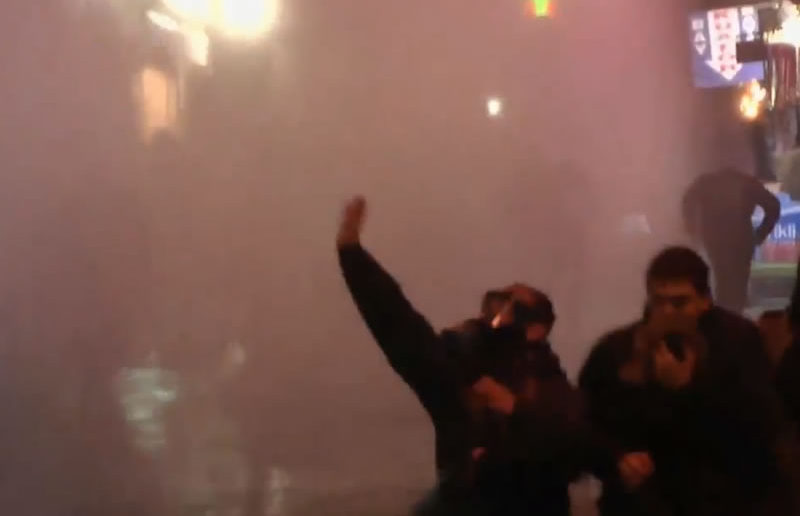
At 18:30 twitter erupted with reports of police firing rubber bullets and tear gas to disperse crowds. Members of the public, with their shopping bags, ran up Istiklal Street away from the clashes. They had scarves wrapped around their faces in an attempt to avoid the teargas.
Shocked to see such force most of the crowd booed and shouted slogans at the police.
Over the next two hours the streets around Istiklal were a maze full of people, protesters, members of the public and lost tourists. A TOMA (riot control vehicle) was moving up and down Istiklal Street firing high pressured water down the adjacent streets in an attempt to disperse people.
Protesters fought back throwing rocks and fireworks down the street. Around 20:00 it looked like the protestors had the upper hand. They had torn chunks of wood and metal sheeting from building sites and formed series of barricades on Istiklal and in the surrounding streets. In one case men were piling planks of marble and steel girders to form a defence against the TOMA.
An hour later the police had upped the levels of tear gas and anyone without a gas mask had to leave the area or take a break in the bars surrounding Istiklal. Staff were happy to hand out lemons and milk, which when combined form an antidote to the burning tear gas.
By 22:00 police had cordoned off the street. Armed with shields and gas masks they made it impossible for people to congregate near the street. Trucks and small diggers were working in the main street to clear the piles of rubble.
With Istiklal firmly back under police control and any protestors dispersed there was little chance of further clashes. By 10am the next day Istiklal was back to normal. Full of the usual Saturday morning crowd out shopping. The only evidence of the previous night was the white paint on the walls, covering last night’s graffiti and the new collection of pot holes.
More protests are forecast for tonight, but so far the government is refusing to acknowledge the protests. Today the pro-Erdogan newspapers are full of pictures of a pro-AKP rally at Ataturk Airport.
This refusal to acknowledge last night’s protests is not surprising. The same attitude was taken during the summer protests.
Erdogan has been in power for 11 years and many critics suggest he is suffering from hubris syndrome – a condition which affects leaders that have spent more than a decade in power. Until he concedes that his fellow citizens have real grievances against the way they are governed the protests look set to continue.