
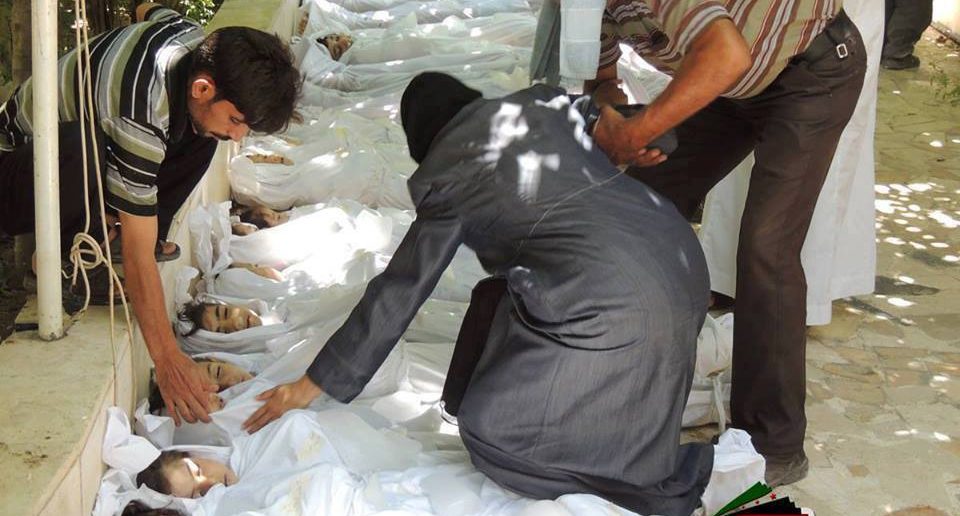
Man carries his child, killed in the chemical attack in Ghouta, Syria. Photograph via Carol Anne Grayson
The West reeled in horror as various sources emerged with footage from Syria showing the effect of alleged chemical attacks that has left over 350 dead in Damascus. Under Obama’s leadership, Britain and France have flatly condemned the attacks as illegal, but the Kremlin has voiced a different attitude, one that downplays the need for intervention and blames the rebel opposition for the deaths.
In June, The World Outline reported on Washington’s reaction to the first suspected use of sarin gas by Assad on his own people, quoting a White House representative speaking on behalf of the Obama Administration: ‘the use of chemical weapons violates international norms and crosses clear red lines that have existed within the international community for decades’.
The attacks came despite assurances in July 2012 from Syrian Foreign Minister, Jihad Makdissi, that chemical weapons would never be used by the government against its own people. However, his words seemed hollow when the The Washington Post claimed that ‘Syria is thought to possess the world’s third-largest stockpile of chemical weapons after [the]United States and Russia’, consisting largely of mustard gas and sarin.
As it stands, President Obama has described the attack as ‘a big event of grave concern’, but, in the same interview also expressed caution. Whilst Washington seeks clarification over the use of chemical weapons, it is clear that they mark the absolute limit of tolerance before intervention is deemed a necessity. The problem for Obama is that he knows how costly military intercession could be, both in terms of resources and personnel, and he was keen to emphasise the fact ‘we’re moving through the UN to try to prompt better action from them’. His obvious frustration with the supranational body is perhaps only outweighed by the fear that intervention will possibly worsen the situation.
Indeed, he stated ‘sometimes what we’ve seen is that folks will call for immediate action, jumping into stuff, that does not turn out well, gets us mired in very difficult situations, can result in us being drawn into very expensive, difficult, costly interventions that actually breed more resentment in the region.’ The US has, of course, learnt the hard way through intervention in Vietnam, Iraq and most recently, Afghanistan.
Chuck Hagel, US Secretary for Defence, has stated that the US is ‘positioning our forces….[ahead of]whatever options the president might choose’. There are now four US Navy vessels in the region, offering significant firepower capabilities should they be required. However, cruise missile attacks on key installations can never be as effective as boots on the ground. It remains to be seen whether President Obama will give the go ahead.
France and Britain, perhaps the closest NATO allies of the US, have been similarly vehement in their condemnation of the attacks. The French Foreign Minister, Laurent Fabius, stated that force maybe a necessary response to the Assad regime’s unlawful use of chemicals, but was also careful to avoid being overly-committal: ‘There would have to be reaction with force in Syria from the international community, but there is no question of sending troops on the ground’. From a NATO perspective, it is positive to see France asserting itself, particularly when a recent defence White Paper has promised so many cuts and capability reductions, but it is also not surprising that Paris has ruled out sending troops to Syria when it is occupied with Mali.
Britain has been less vocal, with White Hall awaiting explicit confirmation of chemical weapon use before elaborating on a potential course of action. In a statement more muted than his French counterpart’s, Foreign Secretary William Hague said ‘I know that some people in the world would like to say that this is some kind of conspiracy brought about by the opposition in Syria [but]I think the chances of that are vanishingly small and so we do believe that this is a chemical attack by the Assad regime.’
Sharing Obama’s view, Hague has been pressing for a solution via the UN, not least because Britain has no power-projecting aircraft carriers, its forces are still withdrawing from Afghanistan, and it is preoccupied with Spain’s sovereignty claim over Gibraltar. He stated ‘the British government should now initiate steps with our allies on the UN Security Council to secure the agreement of a fresh resolution which not only condemns the use of chemical weapons but specifies the mandate of the UN inspection team already in Syria to include East Ghouta.’ This is a commendable step, but there is nothing to suggest Assad would be deterred by such a resolution alone.
Finally, Russia has somewhat bucked the trend of international responses to the Syria crisis. Whilst it has ‘urged Syria’s government to cooperate with U.N. experts’, it has also blamed the rebels for fabricating the attacks in order to bring external pressure onto the Assad regime, and holds them responsible for ensuring the safety of the UN delegation. As one of Syria’s key allies, it is in the interest of Russia to prevent overt Western influence there, and ensure it maintains its own influence in the region.
Alexander Konovalov, president of the independent Institute of Strategic Assessments, Moscow, stated that ‘Russia isn’t ready to jump to conclusions. It seems to us that the West is far too eager to apportion blame before all the facts are in’. He continued that many Russians are ‘skeptical of these reports, with good reasons. How convenient is it that this supposed attack happened just as a UN chemical weapons team was visiting Damascus? And another thing, why would anyone trust the rebels?’ Clearly, some in Russia still hold faith in the Syrian government. However, Putin must be given credit for the clever game he is playing; by supporting the UN’s search for evidence, he avoids incurring the wrath of the West, but this cannot hide the clear gulf in morality that divides East and West.