

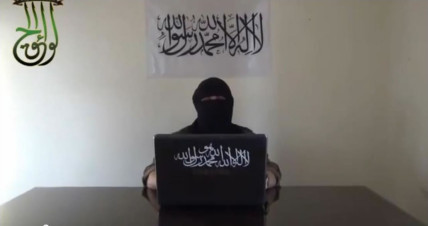
Still from a YouTube video announcing a coalition of Jihadist groups in Syria
The last month we witnessed some major evolutions in the organisation of the Jihadist struggle in Syria.
Ever since al-Qaeda leader, Ayman al-Zawahiri, released his appeal to support Jihad in Syria on April 7th, there were some apparent shifts in who is in the lead organising the attacks on the regime’s forces. As pointed out in this previous post, a few days after al-Zawahiri’s statement, the leader of al-Qaeda in Iraq (the Islamic State of Iraq) Sheikh al-Baghdadi claimed that Jabhat al-Nusra was actually just part of his organisation; thus proclaiming a greater Jihadist movement in Iraq an Syria. Muhammad al-Julani, JN’s leader, responded just under 24 hours later. He denied that Jabhat al-Nusra was part of this unified Jihadist movement. Jabhat al-Nusra would keep up their own agenda and not get involved in this new, greater, international movement. al-Julani did however, renew hisbay’a (oath of allegiance) to the al-Qaeda central command as represented by Ayman al-Zawahiri.
Here are some of the most important statements of his publicly published audio-message (as pointed out by Charles Lister):
- JN leader al-Julani renewed his pledge of bay’a to AQ leader al-Zawahiri.
- The renewal indicates that he had previously pledged bay’a to al-Zawahiri as a member of AQI. In other words, JN was already AQ before the April statements from al-Baghdadi and al-Julani.
- The swearing of bay’a to al-Zawahiri itself is as clear an indication of a group’s loyalty to AQ as you’re ever going to get.
- al-Julani wants JN to be recognized as an independent AQ affiliate and not a subsidiary of AQI or its front group, the Islamic State of Iraq. It also indicates an element of competition between al-Julani and al-Baghdadi to assume responsibility for JN’s comparative success in Syria.
- This does not mean JN is an autonomous actor in Syria detached from AQ leadership in Af-Pak.
- It is extremely unlikely that JN’s original creation in Syria by senior members of AQI could have occurred without al-Zawahiri’s knowledge and permission. In fact, the first statement in which al-Zawahiri explicitly covered developments in the Syrian revolution came on 27thJuly 2011 – the month when JN was actually created (although it formally announced its emergence in January 2012, several 2013 interviews with JN commanders indicate the group was created in July).
- This suggests the continued leading role of the AQ’s Af-Pak-based senior leadership in directing core AQ policies and strategies in Syria and across the world.
- By stressing his intention to continue operations in Syria under the JN name and with the same “policies”, al-Julani is attempting to prevent the deleterious impact an affiliation with AQI might have on his group’s reputation amongst Syria’s civilian population (resulting from AQI’s history of brutality and subjugation of Iraq’s civilian population).
- This does not mean he is separating himself from central AQ’s leadership command & orders.
Another great piece of work on this matter was published on Joshua Landis’ blog by Aron Lund. Here are some highlights of his analysis:
- Harakat Ahrar as-Sham warns that Jabhat al-Nusra’s open affiliation to al-Qaeda will help the regime and that it will “regionalize” the crisis by bringing other parties into the conflict, presumably in reference to US and European hostility to al-Qaeda.
- Harakat Ahrar as-Sham also takes care to point out that they agree in principle with the al-Qaeda goal of establishing an transnational Islamic state, but asks for a bit of realism and patience given the current situation. They also say that none of today’s Islamist factions is strong enough to assume religious leadership over the Muslim community
- This dispute illustrates the subtle but real distinction between al-Qaida’s radically internationalist salafi-jihadism and the more locally rooted, Syria-focused and somewhat pragmatic salafi program of Ahrar al-Sham and the SIF.
Then, things started to change rapidly on the ground. On April 24th a new coalition, Ma’arakat al-Jasad al-Wahid (not including Nusra) was formed. This new unified group was to attack al-Assad’s forces in Latakkia province, the heartland of the al-Assad regime (see previous post). Then Hezbollah got involved on a major scale in the Syrian conflict. The Israeli airforce attacked Syria twice (see video collection). The attacks, directed against Hezbollah’s, were reported by some people on Twitter immediately after but they pointed to Jabhat al-Nusra as being responsible for the damage done to Assad’s military. It soon proved to be a wrong statement.
Another worrying thing: al-Assad’s forces started ethnic cleansing in the ‘Alawi heartland on the Syrian coast. Several hundreds of Sunni muslims were killed in the towns of al-Bayda and Baniyas. The regime leader in command was even proud of it and posted statements about the sectarian cleansing on his facebook account, he even made it to al-Arabiyya.
Maybe surprisingly, there were no official press or media releases by Jabhat al-Nusra since April 13th. Then, on May 7th, Harakat Ahrar-as-Sham al-Islamiyya published a statement in which they claim a coordinated attack with Jabhat al-Nusra in Khan as-Sheykh, in the Damascus neighborhood.
Today, May 9th, yet another unification of Syrian Islamist groups was announced. This time it is a broad alliance of several Islamist groups, joining forces in order to revenge the Baniyas massacres; their main goal is a renewed attack on the strategic city of Idlib (see map). Groups involved in the new coalition are: Liwa’ al-Haqq, Jabhat al-Nusra, Harakat Ahrar as-Sham al-Islamiyya (Liwa’ Badr and Liwa’ al-Iman), Kata’ib Ahrar as-Shamal (recently joined al-Nusra with + 3000 fighters), Suqur as-Sham (Liwa’ Dawoud, Liwa’ Ahfad as-Sahaba), Liwa’ Dera’a at-Thawra, Liwa’ Dara’a al-Jabal and Liwa’ al-Huriyya. In this video Liwa’ al-Haqq announces the unification and the aim of the operation:
Again, Jabhat al-Nusra remains silent, but it is expected that they will react soon once the internal strife amongst the several groups is cleared.
Acknowledgements to: Charles Lister, Joshua Landis, Aaron Y. Zelin, Aron L, Shami Witness, Aymenn J Al-Tamimi, and Phillip Smyth