
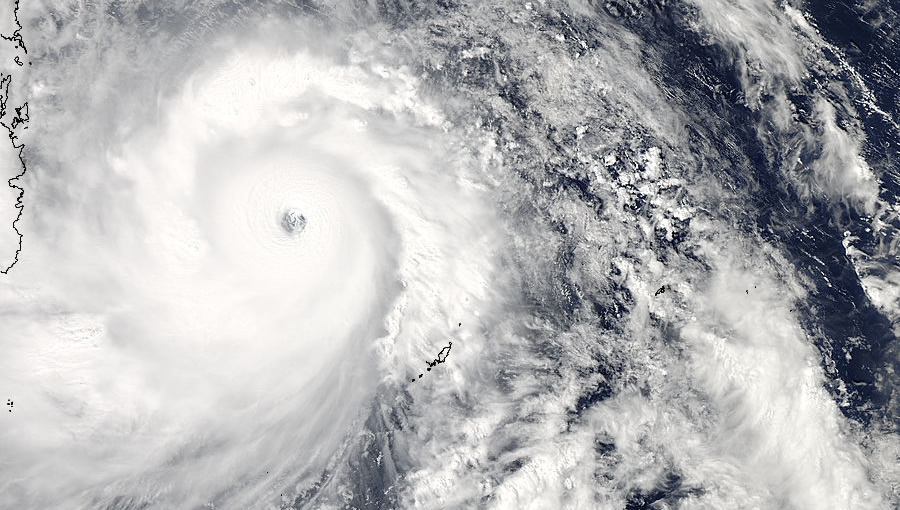
Satellite image of Typhoon Haiyan approaching the Philippines. Image courtesy of NASA Goddard MODIS Rapid Response Team
Aid operations are struggling to reach those affected by Typhoon Haiyan three days after the storm struck the Philippines.
More than 10,000 people are believed to have been killed with hundreds of thousands displaced as torrential rains and 320 km/h winds ravaged parts of the archipelago in one of the most powerful storms on record.
Airport runways and many roads are badly damaged, hindering the supply of aid to affected areas, with some towns reportedly still without an effective operation to help those in severe need.
More than nine million people were affected by the storm, with many left without food, water, or shelter.
Haiyan, known as “Yolanada” by those in the Philippines, reached landfall in Leyte and Samar provinces in the east of the archipelago on Friday before heading west through six central islands.
Aid experts, dispatched by Oxfam to assess the situation soon after the storm hit, described scenes of “utter destruction” in Daanbantayan, the northern-most tip of Cebu mainland where people were left with no electricity and people held signs asking for food and medicines. 98% of the houses and structures in the area are reportedly left damaged after the storm.
Tata Abella-Bolo, a member Oxfam’s emergency team in Cebu, said:
“The scene is one of utter devastation. There is no electricity in the entire area and no water. Local emergency food stocks have been distributed but stocks are dwindling. The immediate need is water, both for drinking and both for cleaning,” said Tata Abella-Bolo, a member Oxfam’s emergency team in Cebu”