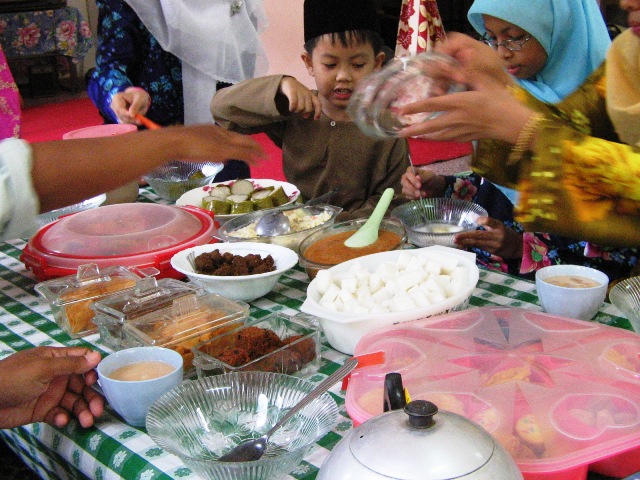
A family celebrate Eid Al-Fitr in Malaysia. Photograph by Syefri Zulkefli
After a month of fasting between dawn and dusk, Muslims around the world are today celebrating Eid Al-Fitr, the end of Ramadan.
The sighting of the new moon brings with it scenes of merriment and festivities with families and friends getting together to exchange gifts and enjoy a feast.
Ramadan follows a lunar cycle, and observing the fasting is one of the Five Pillars of Islam, and central to the faith as Muslims believe this was the month in which the Quran was sent down to the lowest heaven and prepared for revelation to the Prophet Muhammad by the Angel Gabriel. Muslims are expected to refrain from eating or drinking anything between dawn and dusk each day, an action which can be difficult especially when the lunar month falls in the summer when one would normally drink a lot of water to stay hydrated. In fact the word Ramadan comes from the Arabic root “ramiḍa” meaning dryness.
With Muslims from all sectors of society fasting at the same time, and experiencing the same difficulties of hunger and thirst, many see the month of Ramadan as a great equaliser across the community.
Fasting for such long hours has a physical toll on the body, and as such whilst adult Muslims are expected to observe the fast, there are exceptions for children and those who are pregnant, breastfeeding, menstruating, travelling, ill, or diabetic.
Whilst Muslims fast throughout the day, many are surprised to learn that it is rare for people to lose weight during the month, with the breaking of the fast each day, known as Iftah, often a daily feast with family and friends.
In many Muslim-majority countries, the breaking of the fast every evening is a community-wide occasion with Christians, Jews, Hindus, and others all welcomed to share in the daily feasts by Muslim families and groups. In the West, these celebrations are more generally within the Muslim communities, but as the number of Muslims in the cities grows, more families are opening their doors to non-Muslim friends and neighbours to share in the festivities. There are currently around one million Muslims in London, making up an eighth of the population of the British capital.
As the crescent moon appears to begin the new lunar month, the fasting of Ramadan comes to an end with the festival of Eid Al-Fitr which can be celebrated for up to three days. During the festivities Muslims often greet each other with the words “Eid Sa‘īd” (Happy Eid) or “Eid Mubārak” (Blessed Eid) similarly to how Christians use “Happy Christmas” around the 25th December.
Part of celebrating Eid Al-Fitr is giving to charity, known as Zakat, which they do before offering Eid prayers. The traditions of how people celebrate Eid varies from country to country, but in general the central themes are to show happiness, celebrate with other Muslims in the community, and to pray.
How do you celebrate Eid in your community?
Eid Mubārak everyone!