
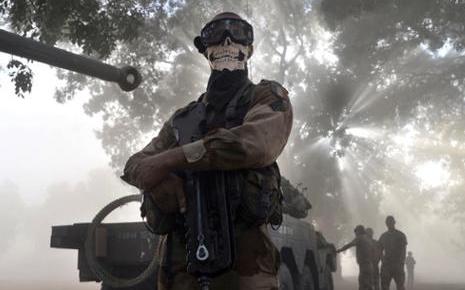

French soldier wearing a skeleton scarf. Photograph by Odieux Connard
Since the start of Operation Serval in Mali, this photo has been seen and shared around the world.
In fact, this image of a French soldier wearing a scarf with a depiction of death’s face has become a symbol to mark the start of French military operations in Mali. But why has this soldier made such an impression on the imaginations of Net surfers?
Reasons for the Controversy
Operation Serval is unfolding to a mixed reception of welcome greetings from the majority of the Malian population and accusations of neocolonialist intervention from others. Its goal is two-fold: protect the civilian population and take back cities being held by Jihadist groups. This explains why the French army is facing a huge challenge in terms of a communications strategy. But should we really be having a scandal over a scarf when an armed conflict that will claim many victims is taking place? This is what the author of the blog “Odieux Connard” points out in his post, “the scarf of war”:
Thus, indignation has made the rounds, and one after another, brave militants of the Web have felt obligated to cry scandal and ask the military brass to do something to punish the man whose choice of scarf design made him look like Ghost, a character wearing a similar-looking balaclava in the “ultraviolent” video game, Call of Duty…. Fortunately, there were many who tried to calm the waters by asserting that the soldier was just “protecting himself from the sand,” which is a valid point. But whether he was wearing it to protect against the sand, the sun, or to smoke a pipe doesn’t really matter. The real problem is that clearly, some people were not told exactly what a war is all about
Obsession with War Imagery
This aggravated focus on the image that the military intervention might project is also annoying to Electrosphère. He writes:
The image has quickly become a gold mine for the politically correct of all stripes who, strangely, have no objections to the weapon being carried by this soldier or his daily actions. So this is a good time to recall certain realities about the job of legionnaire and the act of war to the sanctimonious 2.0 (and other PC people using Windows/Android/iOS) who ‘want to know more, but not too much,’ regardless of whether you approve, disapprove, or question the French intervention in Mali against the Jihadi militias. You really have to wonder about the reasons for a controversy based on a scarf that, at most, might draw indifference, laughter, sarcasm, or admiration in the halls of any high school in Paris or artist’s opening in Lyon. I am even more surprised that the military structure in its cozy, climate-controlled offices in Paris wants to apply sanctions to this soldier.”
Aurélien Legrand would like people not to be so quick on the draw in reacting to the slightest hint of poor taste appearing on the web:
What annoys me the most is the knee-jerk reaction, the torrents of correct thinking gushing immediately over the Net when their words would have benefited from a bit of mulling over first. Our cultural milieu doesn’t help. During the hostage-taking in In Amenas, videos taken by cell phones were released to the media in record time. Barren images, beaten bodies… We want information, we want it to be striking-just not too striking.”
Unfortunately, the conflict in Mali looks like it is going to last a while. So it will be interesting to see if the debate over events will surpass the debates over the combatants’ outfits and finally come around to the stakes and consequences for the local population.
Written by Rakotomalala and translated by Diana Rhudick