
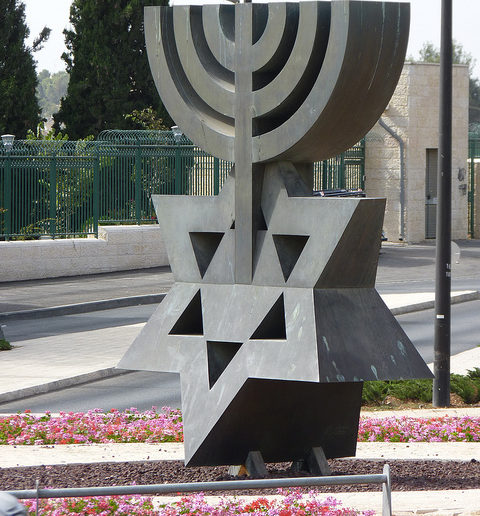
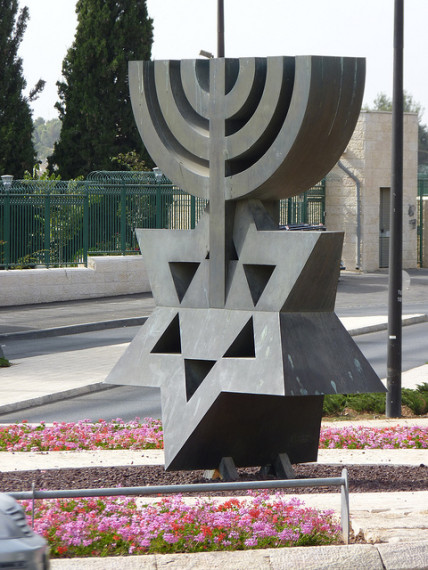
David Soussana’s Sculpture near the Knesset. Photograph by Ricardo Tulio Gandelman
Israelis go to the polls on Tuesday in a general election that is expected to result in current Prime Minister Benjamin Netanyahu retaining his office, but as head of a joint right-wing Likud-Yisrael Beitenu led coalition government.
A total of 34 parties are running in the elections, but only 12 or 13 are expected to pass the two percent threshold, or 70,000 votes, to be elected to the 120-seat Knesset, under Israel’s proportional voting system.
Netanyahu has led a Likud-led coalition since 2009, a government which has failed to engage with the Palestinians, as well as continued to expand Israeli settlements outside of the UN-proposed 1967 borders. Netanyahu’s government has also presided over the regular eruption hostilities between Gaza and Israel, including the recent Operation Pillar of Defense, and the continued threats over Iran’s nuclear programme.
In an effort to consolidate support from voters on the right, Netanyahu’s Likud and Avigdor Lieberman’s nationalist Yisrael Beiteinu were merged to create a party that is expected to win 32-35 votes to be the largest party in the Knesset and return Netanyahu to office.
This political move to the right leaves Israeli Arabs in a difficult position in deciding whether to vote at all. Unlike the first elections in Israel when the founders of the country such David Ben-Gurion saw the Israeli Arab population as integral to the secular state of Israel, current parties on the right such as Likud-Yisrael Beitenu instead emphasise a Jewish state.
If the Arab population would organise and vote as a single bloc in Israeli politics, then they would have considerable sway as they make up around 20% of the population. However, with each Arab group voting for smaller, independent parties they are diluting their vote and marginalising their own power.
Whilst Israeli Arabs can vote for representation in the Knesset, Palestinians are not able to partake in the Israeli elections for the Knesset even though they pay taxes to the Israeli state and are essentially ruled by Israel. Israel continues to blockade Gaza, and Israeli settlements continue to be built on Palestinian land in the West Bank outside of the 1967 borders, and this looks to continue under the next government.
Indeed, Netanyahu has continually rebuffed international demands to allow a Palestinian state with the 1967 “Green Line” border. In a recent interview with Channel 2 in Israel, the prime minister claims that it is for Israeli security that he would not divide Jerusalem or return to the 1967 border, saying:
“When they say: “Go back to the 67 lines” – I stand against. When they say: “Don’t build in Jerusalem” – I stand against”. It’s very easy to capitulate. I could go back to the impossible-to-defend 67 lines, and divide Jerusalem, and we would get Hamas 400 metres from my home.”
Due to in-fighting on the left, the polls are showing that the next Israeli government is likely to be a Likud-Yisrael Beitenu coalition, which moves the government further to the right.