
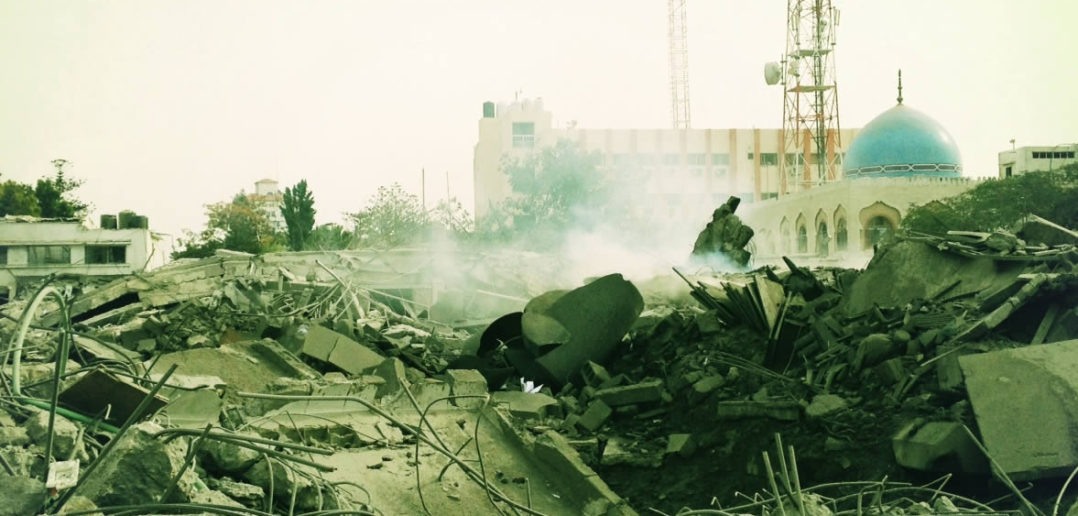
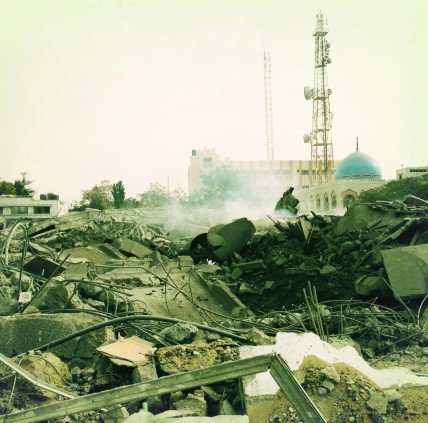
The smoldering Abu Khadra interior ministry compound, hit by 7-8 missiles last night in Gaza City. Photograph by Erin Cunningham
Israel’s PR teams have been pushing the line that Israel had shown restraint throughout the last year by not launching a full-scale bombardment of Gaza before last week after continued Hamas rocket attacks, but if you look back at previous months this “restraint” is a lot more difficult to find.
There is no doubt that Hamas has continually fired rockets over the border in Israel with little regard for targets, whether they are military installations, houses, or schools – with the IDF noting 764 rocket attacks this year up until November 14th. But Israel has also been regularly launching attacks on Gaza, 687 attacks between January and October this year according to statistics provided by the PLO (below).
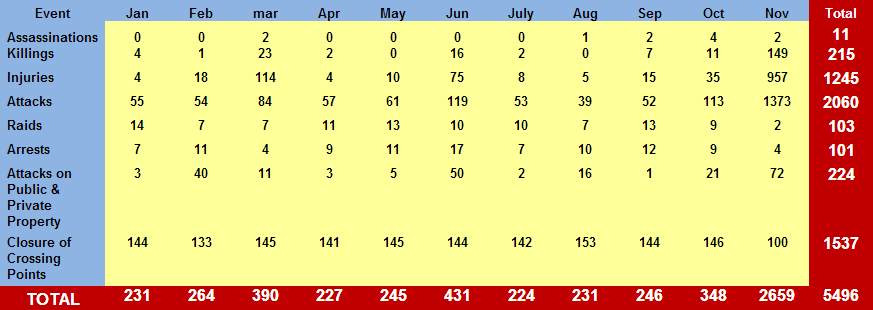
Israeli attacks on Gaza in 2012
The argument as to which side launched their attacks offensively and which launched them in retaliation is moot at this point, with both sides launching similar numbers of attacks on the other. Neither side is in the right, and it is civilians that are the ones that are suffering the greatest cost. Hamas target Israelis indiscriminately with their rocket attacks, but any talk of “surgical strikes” from Israel are misnomers – civilian casualties are an almost certainty when attacks are launched in such highly populated areas.
The blockade on Gaza is also often glossed over in any discussions. Israel has a right to security, and weapons being smuggled to Hamas in Gaza from Iran is a major concern. Policing imports, however, is less of a problem than the complete ban on various goods and materials that are required in a functioning city. Israel did ease these restrictions in 2010, but prior to that people could not import pasta amongst other foodstuffs, or A4 paper or stationary. If such basic goods are restricted then people will find routes to smuggle them in, and that opens up the routes for the smuggling of other objects like arms and munitions. Israel did greatly ease these restrictions in 2010, with only weapons, munitions, and “dual use goods” restricted, but once these tunnels were dug and the flow of goods had started, they are near impossible to close.
Egypt was also involved in the blockade situation as under Mubarak they closed their border with Gaza, again pushing those wanting normal household goods and supplies to the smuggling routes which are now so difficult to find and close. With Mubarak ousted and President Morsi in power, we are already seeing a closer relationship between Egypt and Palestine but what shape will this blockade now take? Will Egypt completely open its border and allow all goods to pass through, or will they also subscribe to limiting access based on the Wassenaar Arrangement lists?
Until the Arab Spring Gaza was situated between an enemy (Israel), and a friend of the US (Egypt), meaning that little was offered by either side. Now with a member of the Muslim Brotherhood in power in Egypt they are stuck between Israel and a possible friend. This changes the entire dynamic of the situation in Gaza, and could mean the beginning of Palestine’s long road to recognition on the international community.