
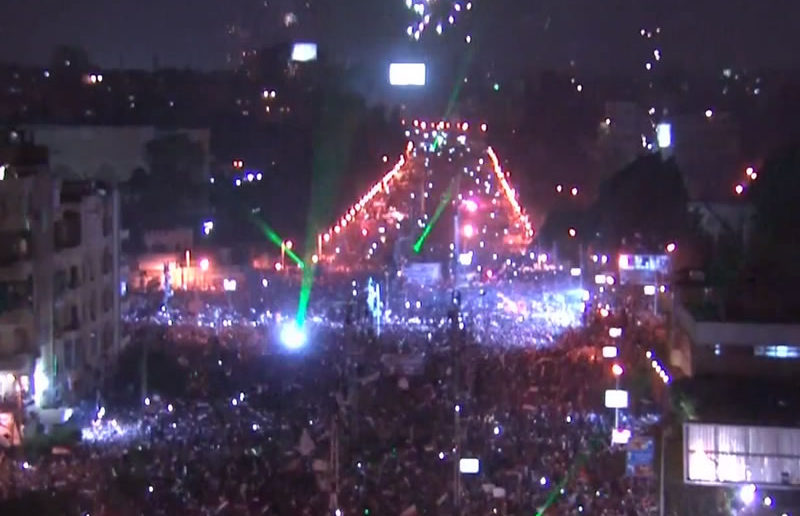
Celebrations in Egypt following the ousting of president Morsi. RT video
Egyptian President Mohamed Morsi has been ousted from power, with the Egyptian army stepping in to end a week of huge protests across the country which were turning increasingly violent.
Morsi was the first democratically elected President in Egypt, being voted into power following the fall of former leader Hosni Mubarak one year ago. His first year in power, however, have been marked with escalating social and economic crises as the country continues to face fuel shortages, high unemployment, and increasing sectarianism.
The protesters complained that Morsi was ruling for the benefit of the Muslim Brotherhood and taking the country in an Islamist direction, rather than ruling for the benefit of all Egyptians. Supporters of Morsi, however, contend that he was democratically elected by the Egyptian public, and whilst his government has not fixed the country’s problems, one year is not sufficient time to judge.
In the last week millions of people have taken to the streets across Egypt both against and in support of President Morsi, with clashes between the groups turning increasingly violent. more than 50 people have been killed in the clashes, with some commentators warning that Egypt could have slipped into a civil war if the crisis continued.
The army issued an ultimatum to Morsi to address the concerns of the protesters or face intervention, and yesterday this deadline was reached. Army chief Gen Abdul Fattah al-Sisi announced that Morsi had “failed to meet the demands of the people” and was put under house arrested, along with his presidential team, and arrest warrants were issued for around 300 top Muslim Brotherhood members. TV channels operated by the Muslim Brotherhood were taken off air, with managers being arrested.
al-Sisi announced the intervention in a televised speech where he laid out a roadmap for Egypt’s future, where the controversial constitution would be suspended, and the top judge of Egypt’s Constitutional Court, Adli Mansour, would be sworn in as interim leader until elections could be held.
The news was met with cheers and celebrations into the night by protesters across Egypt, although there were also a number of clashes with pro-Morsi groups with at least 14 people being killed. Morsi and supporters of the Muslim Brotherhood have condemned the army’s intervention as a “military coup”, with the army overstepping their role in a democracy, whilst the protesters see the army as supporting the will of the people. In Egypt, it appears, the liberals are not democrats, and the democrats and not liberal.
The army has long had a role in Egyptian politics, but some fear they have overstepped their role in a modern democratic society, which is what Egypt was supposed to become after the ousting of Mubarak in 2011. There is no doubt that Morsi had lost much of his support and his policies were failing, but many question whether the army should have intervened rather than wait another three years before ousting him in democratic elections.
However, others argue that Morsi was intent on instilling Muslim Brotherhood power and with the controversial Islamist constitution he established, he may not have relinquished power at the end of his term, and even if he did too much damage would have been done to the Egyptian economy by that point.
Unlike traditional military coups, the army has not established a military general in “interim” control, but instead a major legal figure in Adli Mansour. The army may have been the group to ouster Morsi and the Muslim Brotherhood, but they do not appear to have grabbed power, but instead looked to hand it to the judiciary before elections in the near future. Some army figures have even remarked that Morsi may be free to run in the next elections, although this could not be confirmed.