

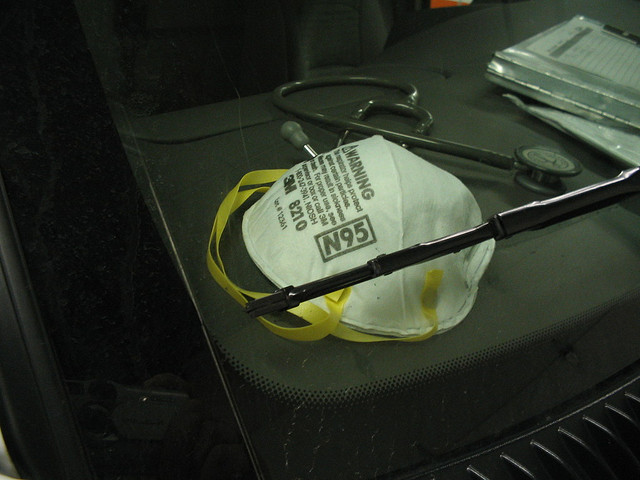

Photograph by Phot0geek
A strain of avian flu never before seen in humans has so far infected 21 people, with six deaths, in China, putting health authorities on high alert and prompting fears among many Chinese of the disease spreading.
The first reported death associated with the H7N9 virus was an 87-year-old man who died March 4, 2013 in the commercial hub of Shanghai, a city of some 20 million residents. More cases were soon diagnosed in the neighbouring Zhejiang, Anhui, and Jiangsu provinces, sparking speculation that nearly 15,000 dead pigs found in a Shanghai river last month might have contributed to the outbreak.
The Chinese government has so far rebuffed [zh] any correlation. An official investigation is underway to pinpoint the source of the virus and exactly how humans have contracted it.
In Shanghai, officials ordered the slaughter of more than 20,000 birds at a local food market on March 5, 2013 where the H7N9 virus was detected in samples taken from pigeon a day earlier. The city also suspended live poultry trade to prevent further spread of the virus.
Two days later in Nanjing, the capital city of Jiangsu where six human cases of H7N9 were detected, authorities followed suit by shutting down all live poultry trade markets in the city.
Sina Weibo, China’s equivalent of Twitter, has been abuzz as users speculated about the origin of the virus, criticized mainland media’s coverage of the outbreak, and drew comparisons between H7N9 and the country’s SARS outbreak a decade ago. The topic has generated some four million comments so far and was among the top 3 trending topic on April 7, 2013.
Yiyi Chuang Jianghu from Henan wondered on the microblogging service about the relationship between the dead pigs and the virus:
I very much want to know if the dead pigs were related to H7N9…
Shanghai top headlines, a Weibo account dedicated to updates of H7N9 information, questioned:
#H7N9# @ShiLiqin: There was once case in Nantong of Jiangsu, [the patient]died in the ambulance (@RenweiNICKY), the hardest hit areas of H7N9 are the areas where lots of dead pigs were found, is there no correlation?
The discovery of human cases of H7N9 invoked memories of the outbreak severe acute respiratory syndrome (SARS) in 2003, which emerged from China and was initially covered up before it spiraled into a global health crisis that claimed some 800 lives worldwide.
Traditional Chinese media this time have responded with relatively more transparency and openness to the avian influenza than it did with SARS. Newspapers have run articles updating infection numbers and calling on people to avoid live poultry.
But the country’s state-run media CCTV was one notable exception. The broadcaster’s widely watched 7 p.m. Xinwen Lianbo news program on April 5, 2013 made no mention of the H7N9 avian influenza, drawing criticism online for its silence.
Prominent Chinese writer Li Chengpeng offered his mixed feelings on Weibo about the media coverage:
Avain influenza happens in every country, and every now and then, the medical circles still don’t have effective medicines. But information is transparent in other countries whereas here what we do is refute rumors and cover things up. To be frank, information transparency has surpassed that of ten years ago, but it is still not enough, in the face of a major epidemic, you need to calm a jittery public apart from solving the epidemic itself. This is what a country needs to do. I pledge that CCTV should report on the epidemic instead of broadcasting rainforests in the Amazon. Don’t stick out your mic and ask, “Are you happy?” I can only answer: “I …. survived.”
Guan Qingyou commented on the parallels between SARS and H7N9 avian influenza:
We are very fearful of H7N9 because we’ve gone through SARS[ten years’ ago]. Ten years’ later, China’s economy has taken on a new starting point. It’s now unclear if H7N9 will spread widely, so it’s hard to quantify its impact on the economy. First, psychological impact will take effect. The plunging of Hong Kong stocks before the holiday had something to do with this. Second, consumption will be affected. People will cut back on eating outside and travelling, consumption is already very weak, [the avian influenza]adds insult to the injury. Then industrial output will be affected. There might be suspensions now and then, all dependent on the intensity of H7N9′s spread.
Written by Owen




1 Comment
Hi,
China: Outbreak of New Avian Flu Kills Six. If you analyze the outbreaks they are as a consequence of very close contact with the avian species, mostly chickens. The consequence is don’t sleep with a hen.