
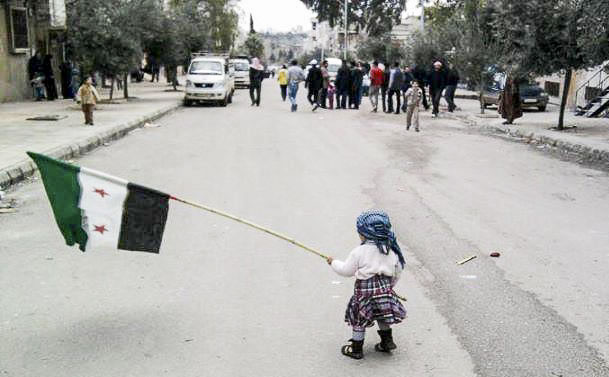
Photograph courtesy of Freedom House
In Washington this month, decisions over Syria were quickly made. Once it was determined that sarin gas had been used by Assad’s men, White House spokesman Ben Rhodes communicated that ‘the use of chemical weapons violates international norms and crosses clear red lines that have existed within the international community for decades’. Although no precise details were given, there was the distinct implication that future shipments would contain more substantial aid; ‘different in scope and scale to what we have provided before’.
In Britain, such decisions have not been forthcoming, and the debate continues over how the government should best assist the largely Sunni rebels; whether delivering weapons into a war zone is an indirect act of humanitarian relief or just plain warmongering. Both sides have publically voiced their concerns, and at the end of last week, John Baron MP, a member of the Foreign Affairs Select Committee, warned of the Pandora’s box that could be opened if arms shipments go ahead.
He told BBC Radio 4 that ‘if you supply the Syrian rebels with more weapons…, how do you know those weapons won’t fall into the hands of extremists’? He was primarily referring to Jabhat al-Nusra, Al-Qaeda’s regional affiliate in Syria, which is thought to have fielded 10,000 fighters, and is described by the Washington Post as ‘the most aggressive and successful arm of the rebel force’. Mr. Baron argued that ‘if you throw more weapons in, it can only create more violence and suffering…. [This could] not only escalate the violence within Syria, but beyond Syria’s borders as well’, and he has a point. If there is a chance that Al-Qaeda could obtain weapons delivered by the West then there is always the possibility they will find their way into other war-torn parts of the Middle East.
On the other hand, Foreign Secretary William Hague, who has vocally professed his concern for Syria in recent months, is refusing to rule out the possibility that weapons shipments may be necessary. In March he told the BBC that ‘you can reach the point eventually where the humanitarian need is so great… you have to do something new in order to save lives’, and earlier in June his plea was for a ‘coordinated response from the international community. We have to be prepared to do more to save lives, to pressure the Assad regime to negotiate seriously’. As the Syrian death toll reached 93,000 last week, he conceded that Britain faces no ‘palatable option’.
In the midst of this is Prime Minister David Cameron, who has not been coaxed into any hurried commitments to Syria. It was perhaps surprising he did not instantly follow Washington’s lead, given the outspoken ‘Atlanticist’ elements within his party pushing for a renewed ‘Special Relationship’. Inevitably, the ghost of Iraq weighs heavily on his mind, particularly the memory that justification for invasion was based on inconclusive evidence regarding WMDs. On top of this are the scars of the rebuilding operation, which collided with an eerily comparable civil war between Sunni and Shi’a militias. In fairness to Cameron, he has not neglected Syria – the British government has contributed £348 million in ‘food, medical care and relief items for over a million people’ – but this will not stop the fighting.
At the G8 summit, Cameron did his best to extract a decision on intervention from his peers but was met with a cold reception, particularly from Vladimir Putin, who discredited reports of chemical weapon use. It is no secret that Putin has an ally in Assad, (he has promised anti-aircraft missiles to deter a potential Western ‘no-fly-zone’), and that neither France nor Germany have the appetite or the military resources for a costly intervention.
In the aftermath, Cameron finds himself fighting a personal battle on several fronts; against the British people, his party, and several European leaders. Few are blind to the reality that any military intervention would result in many further deaths for all parties involved. But now there is the added complexity of a proxy war with Moscow, the playing out of ‘East versus West’ tensions. It was probably particularly cutting for Cameron to hear Putin insist that ‘Syrian rebels are the same as those who killed Lee Rigby’.
As July approaches, The Economist cannot help but express its scepticism: ‘The [G8] summit achieved nothing much for Syria’s people. That was wretched…. Almost no one wants to deploy British troops to the fight.’ Indeed, the British public is weary of its war dead returning in flag-draped coffins, and probably few understand the plight of the rebels.
But fundamentally, Britain cannot afford to send significant amounts of weapons to Syria, let alone intervene with ground troops or a Libya-style air campaign. The military is shrinking by the year – another round of cuts in June announced that 5,000 personnel will be made redundant – and the bulk of Britain’s planned global projection capabilities are still in development. By not acting, Cameron risks distancing himself further from Washington, but by getting involved risks alienating not only Russia, but also the 81 backbenchers who demanded parliamentary approval before action is taken.
Therefore, Cameron finds himself at a critical crossroads, and regardless of the route he takes, someone will have their grievances. And the longer this decision takes the more Syrians that will die. Can Britain realistically stop the fighting or the killing? The uncomfortable truth is probably not, but watching a nation destroy itself is indeed ‘wretched’. This is perhaps symptomatic of Britain’s declining global power, who could certainly not act without considerable assistance from Washington. But here, commitments to Syria are equally restrained; the Iraq experience was much worse for the US. Ten years on and Britain’s obligation to moral intervention is alive and well, but ten years on and the means for action are simply not there.
Written by Michael Jones