
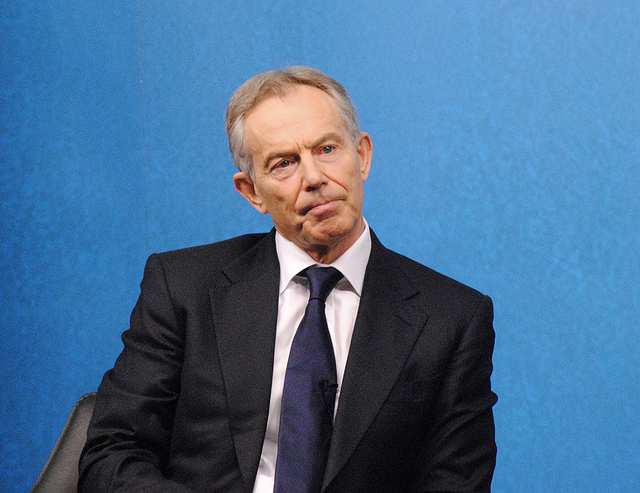
Tony Blair. Photograph courtesy of Chatham House
It has been ten years since British forces accompanied a US task force into Iraq in a bid to topple Saddam Hussein’s regime and uncover his purported weapons of mass destruction (WMDs) that intelligence had warned could be readied within 45 minutes. Whether or not Tony Blair genuinely believed in what he was about to undertake, he certainly did not flinch in the face of a mesmerized public: ‘this new world faces a new threat; of disorder and chaos born either of brutal states like Iraq, armed with weapons of mass destruction, or of extreme terrorist groups. Both hate our way of life, our freedom, our democracy’.
You would be forgiven for believing that Blair saw his as a moral crusade within the greater ‘Axis of Evil’ discourse that had overshadowed the world since 9/11. Whilst his language was perhaps more subtle than his US counterpart, and he at least appeared more committed to the humanitarian cause, the fact cannot be ignored that everything which underpinned the justification for war was a falsehood: what political journalist Mehdi Hasan has termed ‘completely hollow, utterly discredited, false, disingenuous, non-sensical.’
The public autopsy that followed unearthed many skeletons in many closets: the ‘September Dossier’ was proven to be riddled with fabrications and exaggerations, notably the assertion that Saddam was importing uranium from Africa. The Iraq Survey Group found only trace evidence of WMD activity, resulting in its chief inspector David Kay resigning in disgust. Where were the links to Al-Qa’ida? The imminent danger? The great wrong that had to be set right?
The enduring victim of the Iraq War has ultimately been political trust in Britain. The character assassination of Blair has been extensive, with figures such as Desmond Tutu and Harold Pinter arguing that he should be put on trial for war crimes. Since New Labour, the very credibility of the political profession has been questioned, a reputation damaged further by the farcical expenses scandal. Just last month, former Cabinet Minister Clare Short criticised the justification for war as a cover for regime change, asserting that Saddam was targetered because he stood out ‘against Western domination of the Middle East.’ Blair, derisively painted as George Bush’s lapdog, has become the embodiment of corruption in British politics; a monument to all that should be avoided in a governing administration. In 2011, The Guardian quoted intelligence officer Major General Michael Laurie as saying ‘We knew at the time that the purpose of the dossier was precisely to make a case for war, rather than setting out the available intelligence.’
The result has been to create a British public weary of international interference, tired of distant wars that claim the lives of British soldiers and seemingly cause only further turmoil. As argued in The Economist, ‘the experience has shocked Britons, turning a once gung-ho nation against intervention’, banishing ‘foreign policy from the public square.’ Although the loss of life was generally acceptable by military standards at 179 killed in action, many must question what they died for. The war has cost the UK taxpayer £9bn, and even though Iraq’s Human Development Index has risen from 0.564 in 2005 to 0.590 in 2012, can it reasonably be said that the country is safer now than it was under Saddam?
Last month, Conservative MP Bernard Jenkin spoke out in defence of the war, arguing that British success in Iraq has to be measured against the lives of those civilians saved from Ba’athist execution squads and chemical weapons. But this is ultimately a ‘what if’ narrative. No one can possibly say for sure that the 112,000 killed as a result of the war are fewer than the number that would have otherwise died. It is a spurious argument, and too apologetic.
Ten years on and there is much less appetite for ‘kill now to prevent more killing later’, and the Coalition government has appreciated this. A YouGov poll from February revealed that 66% of the British public ‘oppose sending allied troops into Syria to help overthrow President Bashar al-Assad’, and unlike operations in Afghanistan which have benefitted from NATO-backing, intervention in Syria would be unilateral and too similar to 2003 for comfort. There would be no multinational support, no exit strategy, and too many civilian lives at risk. The bitter after-taste of a reckless partnership with the USA lingers on, but so does British detachment from a Europe opposed to the war.
The Coalition continues to feel the effects of the Iraq War, but has arguably learnt from Labour’s mistakes. Troops were not committed to Libya and much more convincing evidence was offered to justify a policy of air strikes there. In Syria, too, restraint is, so far, being exercised, and policy will almost certainly not extend to facilitate boots on the ground. Most significantly, Cameron has been forced to restore Britain’s international reputation, keeping his distance from Washington, and focusing on a foreign policy that backs self-determination, rather than the toppling of unfavourable regimes. Iraq has shown that change must come from inside a country, and should be supported, but never forced. Whilst not abandoning morality, the last decade has shown that British statesmen can no longer change the world on a whim.
Written by Michael Jones