

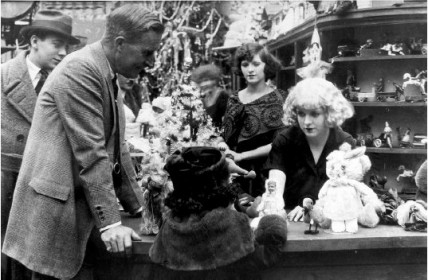
William Desmond Taylor filming Top of New York (1921)
The legendary actress Bette Davis once summed the business of Hollywood up by saying “Acting should be bigger than life. Scripts should be bigger than life. It should all be bigger than life.” However the real lives, and mysterious deaths, of many of its stars are proof positive that fact is often stranger than fiction. Take for instance the curious circumstances surrounding the murder of silent movie star and film director William Desmond Taylor. Largely forgotten today Taylor was at the height of his game when, on the 1st February 1922, he was cold-bloodedly shot in the chest in the study of his home in the upmarket Westlake Park suburb of Los Angeles.
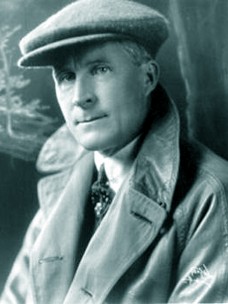
William Desmond Taylor
In the early years of Hollywood’s ‘Dream Factory’, studios churned out numerous films every week to satisfy increasing public demand for celluloid escapism. Taylor, attractive and charismatic, had little difficulty finding work, acting in twenty seven films between 1913 and 1915. However it was as a director that he really came into his own. Between 1914 and his death in 1922 he helmed an astonishing 59 films, many like Captain Kidd, Jr. (1919) starring the legendary Mary Pickford considered classics of their time.
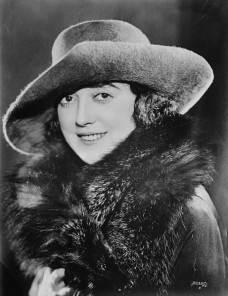
Mabel Normand
Significantly, Taylor’s death could have been the end of Hollywood if the censors had had their way. Worried by the effect the lives of stars like Taylor and Normand were having on impressionable fans, moral campaigners pressurised Hollywood to clean up or shut up, though considering the scandals of today it’s debatable how successful this was. In fact it’s probably as bad now as it ever was, and is summed up by Jay Leno when he talked about the popular thoroughfare which runs through the heart of film-land. “If God doesn’t destroy Hollywood Boulevard”, says the present day chat show host, “he owes Sodom and Gomorrah an apology”. So, clearly things haven’t changed much in the intervening years.
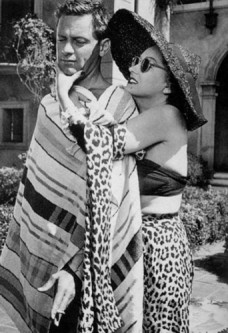
William Holden and Gloria Swanson in Sunset Boulevard (1950)
Another clear reference to the scandal was by writer Gore Vidal, who died recently, when he included an account of Taylor’s murder in his novel Hollywood, an epic satire on Tinseltown’s heyday. Though fictional, Vidal’s prose only enhanced Taylor’s already shady reputation and the continuing mystery surrounding his murder. “On the other hand the telephones of Hollywood had not stopped ringing all that morning and everyone in any way concerned knew of the murder. While the press continued to print salacious stories about Taylor’s womanising the police spoke only to the thief, Eddie, who had vanished.”
Westlake Park is now a nondescript part of Los Angeles, lost within its ever increasing urban sprawl. Taylor’s bungalow on Alvarado Street is itself long gone (a parking lot covers the area on which the house once stood), confined like the murder itself to the annals of Hollywood’s troubled and murky past.
Cleaver Patterson
Food for Thought
If the mysterious death of William Desmond Taylor has made you want to investigate Tinsel Town’s grimy underbelly further why not check out L.A Confidential (1997), Curtis Hanson’s Oscar winning take on the darker side of Hollywood, or Billy Wilder’s timeless Sunset Boulevard (1950) for a glossier though equally seedy approach.
Amongst the numerous books out there on the film industry’s dubious past a few stand out. Murder in Hollywood: Solving a Silent Screen Mystery by Charles Higham (2004, University of Winsconsin press), claims once and for all to solve the mystery surrounding Taylor’s murder, whilst Kenneth Anger’s perennial classic Hollywood Babylon (1981, Random House Publishing) uncovers the truth behind many of the sordid secrets the film makers would rather we never knew about.[/note]
Written by Cleaver Patterson