
Quite exceptionally, Paul Thomas Anderson is one of the very few and all-too-rare American directors who refuse to conform with the hard-fast rules of Hollywood film-making, progressing with films that become increasingly defiant in form. His previous work, the seemingly narrative-less yet searing oil-baron drama There Will Be Blood, has catapulted him as one of the finest cinematic purveyors of humanity’s modern malaise, with an artful yet unaffected approach to his craft. His latest creation, aptly titled The Master, contains perhaps the best of what Anderson can do – and that could be proven an understatement, given that this is exactly the same guy who rewarded us with a thematically rich oeuvre consisting of Boogie Nights, Magnolia and Punch-Drunk Love.
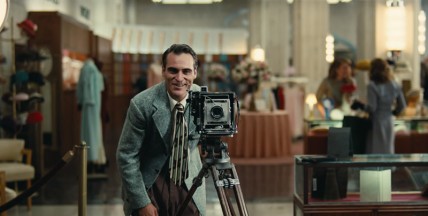
Sticking up a middle-finger to the pervading digital age, Anderson films The Master entirely in 65mm celluloid (the only film to do so since Kenneth Branagh’s 1996 Shakespeare adaptation Hamlet) and is projected on the silverscreen in 70mm format. I happen to see it in Odeon West End, the only cinema across Britain to exhibit in its vintage, pristine form, and it contends to be the most beautifully composed film of 2012. Luminous and touch nostalgic, Francis Ford Coppola’s mainstay cinematographer Mihai Malaimaire Jr.’s pitch-perfectly frames Anderson’s tale of post-war disillusionment with burnished glow and soft-hued varnish, whether it be bathing Philip Seymour Hoffman’s enigmatic cult-leader Lancaster Dodd in immaculate light or dipping Joaquin Phoenix’s remarkable facial features in ominous shadows in a superbly staged ‘interrogation’ sequence. There’s nary a frame badly mounted. The film captures 1950′s America in an almost Sirkian post-coital splendor – an aesthetic that befits a nation in a desperate state to find meaning and happiness after a postwar existential gloom.
For those expecting a grand cinematic vision of Scientology and its origins, disappointment will arise. Anderson isn’t bothered about pointing a direct finger to a specific quasi-religious science group, but rather points all fingers to all cults in all their forms and sizes. In an ingenious scene where a curious spectator demanded an answer from the leader of The Cause to the question ‘Isn’t science the based on the will of one man the basis of a cult?‘ leads to Dodd (a magnificently commanding Hoffman) losing his cool reserve and commits to a rather visceral outburst. The Master is about Scientology as much as Magnolia is about raining frogs. No, the film is about the men that forcibly lead fanatical groups, the men that gathers a flock of misguided followers, charm the weak-willed and are outraged by the mere raising of questions. Just about every religious group ever formed on Earth.
And yet Anderson use this as a canvas where the central character dynamics ebb and flow. At the heart of The Master is a metaphysical courtship between two disparate men at odds with the truth. On one hand, we have a psychologically traumatised war veteran Freddie Quell (Phoenix acting at his most startlingly unconstrained and supreme best), a walking Pandora’s Box of chronic social dysfunction, violent outbursts and sexual unfulfillment, and Hoffman’s magnetic yet mischievous Dodd, a charismatic, compelling figure who is also part-opportunist and part-charlatan. Both their chronic illusions draw them together, captured in an extraordinary one-take sequence where Quell goes through Dodd’s self-styled ‘auditing’ process, repeatedly asking Quell personal questions without ever blinking. Anderson breaks down the psyches of these two men – the subservient simpleton and the manipulator – both in doomed denial of truth. It’s a dramatically intense scene and psychologically revealing – peeling human layers using the merciless technique of unblinking, extreme close-up. It’s a sublime testament to Anderson’s powers as a film-maker of understated nuance, captivating The Master‘s essence in a single scene. This moment gathers resonance in a later sequence when Quell unexpectedly rides away into the horizon, breaking his devotion to his leader, and Dodd, in his disappointment, throws Quell back to his stone-cold reality. A meaningless existence dry-humping a sand woman on a beach. Religion and reality don’t go hand-in-hand gliding into the sunset.
This is pure, ravishing cinema – undulating with tragedy, complexity and sublime technical command. There is hardly a film this year as beguiling and astonishing as Paul Thomas Anderson’s artful study of the human psyche and our species’ grandstanding capacity for self-delusion in a meaningless world. The Master is, for the lack of a better word, a masterwork from a film-maker at the height of his craft.