

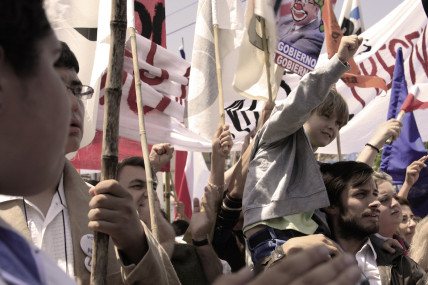
There’s probably no better way Pablo Larraín could have concluded his thematic trilogy-of-sorts revolving around Augusto Pinochet’s 17-year iron-fist dictatorship of Chilean politics than this rousing tale of an ad man who led a ‘nay’ campaign that brought the inevitable demise of the despot’s ruthless rule. Following his critically acclaimed works Tony Manero and Post Mortem, the sparingly yet effectively titled No is a superbly judged film about how propaganda play in shaping a nation for better or worse, and how learning to say ‘no’ to the ills of society can end an era of collective suffering. This is, without a scintilla of doubt, the director’s most accomplished work – a thoughtfully assembled museum piece that celebrates people power and advertising as a weapon to galvanise activism.
Larraín’s film could never be more fitting, justified and eloquently delivered, given the tumultuous and heavy historical baggage that Chile was dragging for almost two decades. No has such a clarity of purpose that not for once you’d disbelieve Larraín’s narrative. It’s also a hard film to sell – eschewing the sheen of digital mass-market gloss and instead opting for a retro 80′s broadcast television aesthetics, employing a U-matic video camera, all in 4:3 ratio, washed out tones and fuzzy edges you’d think somebody has dipped some hallucinogen in your drink. It’s mildly distracting at first, as if you’re watching some crappy-looking telenovela played on an obsolete Betamax tape. But this isn’t without a purpose. Larraín is not merely playing some random visual schematics. He boldly intercuts his drama with real historical footage in a seamless, elaborate and wholly convincing experience, going so far to depict period authenticity.
It’s an appropriate choice, pulling you closer to the events that unfold as Gael Garcia Bernal’s jaded and cynical René Saavedra proves to a posse of naysayers that only happiness can fight sadness – eviscerating images of torture and national suffering and assembling a commercial reel comprising of feel-good kitsch, rainbow-coloured scheme and impossibly hip and happy people suitable for a pop soda advert. In a different setting, this would feel wrong, but in the context of Chile’s public horrors, it’s what the nation needs. It’s not so much bullshitting as providing optimism and positivity to a country that was severely lacking of, and René understands this language of advertising. It’s a soulful, magnetic turn by Bernal, giving the film a much-needed human core. He’s Don Draper in a bomber jacket and skateboard, a genius in his profession but a failure in his private life, seeking to take refuge in his work. There’s a scene where René is forced to leave his son with his estranged wife, the camera capturing every emotion askance in Bernal’s face, a withered, profoundly terrified and heartbreaking look of a man who realises the danger he’s brought to his own family – a shot mirrored in the end as it slowly dawns on René the magnitude of his involvement in Chile’s pivotal current affairs. This is a portrait of a nation’s political awakening seen through the eyes of a man who thought his job was made of bullshit.
Don’t let the television aesthetic distract you, this is the crown jewel in Pablo Larrain’s trilogy of Pinochet’s dictatorship. No is incisive, insightful and unexpectedly moving, anchored by an understated, sensitive performance by Gael Garcia Bernal.
Written by Janno Datinguinoo