
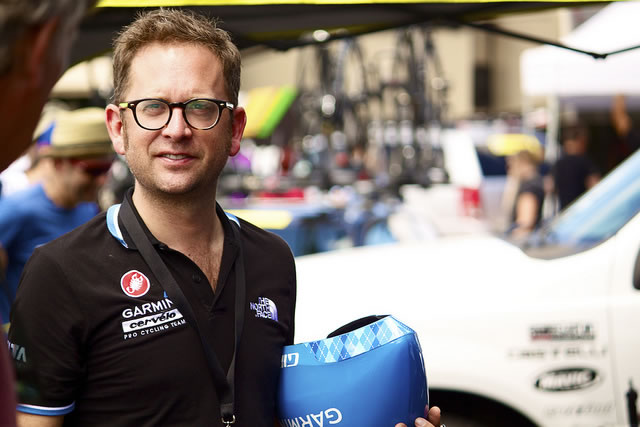
Jonathan Vaughters. Photograph by Richard Rhee
By now, most people who care about these things have read Jonathan Vaughters’s New York Times op-ed, “How to Get Doping Out of Sport,” in which the former Tour de France rider confesses to doping during his professional cycling career.
As an argument for why the war against doping is worth fighting, it’s an exceptional piece. I hope that it will be widely read, especially by those who say that “everyone’s doing it” and therefore the easy solution is to just legalize drugs. The essay is also a powerful counter-argument to those who acknowledge cycling’s dirty past, but insist that it’s time to “just let it go.”
But as a confession, Vaughters’s essay is a self-serving pile of PR—a textbook example of how public figures use the media to cultivate their images and influence the stories that get told.
Vaughters retired at the end of 2003, and his doping history has been an open secret for some time, because he’s made a point of evading doping questions not with denials, but with vague hints, like the one he gave John Henderson of the Denver Post. “I’m not here to talk about my past. You can read into that anything you want.”
So why confess now? Because the U.S. Anti-Doping Agency is proceeding with a case against Lance Armstrong, which accuses Armstrong and his associates of a conspiracy to promote systematic doping. It’s been reported that Vaughters was one of the former Armstrong teammates who offered testimony in the case. As the case moves forward, Vaughters’s secret will out.
The New York Times piece was Vaughters’s chance to own the narrative. And in his telling, he’s not a lying cheater, he’s a victim of lax anti-doping rules that forced him to choose cheating. He was an awkward kid (with a Goofy alarm clock!) who just wanted to live his dream. His transformation into a doper wasn’t a moral failing, a lapse of judgement, or a choice to place winning ahead of fairness or truth. No, his decision to dope was a result of ambition, “a trait we, as a society, generally admire.” That’s right, it was his inherent goodness “in a world where rules aren’t enforced” that made him do it.
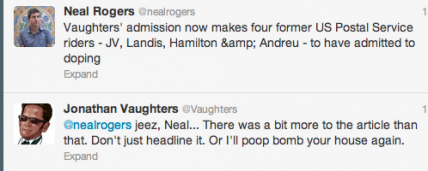
Vaughters scolds VeloNews reporter Neal Rogers for veering from his carefully crafted narrative.
In 2003, I interviewed Vaughters for a Bicycling article about doping. “People tend to forget that this is how cyclists earn a living,” Vaughters told me. “People in mainstream jobs drink four cups of coffee to be prepared for their 8 a.m. meeting–it’s the same thing.” Got that? Sometimes drugs are necessary to make money at your job. “If everyone is doing the exact same thing, then even if it’s technically outside the rules, it’s not giving anyone an advantage,” he told me. “Was taking EPO cheating in the pre-Festina era of cycling? At that point in time you had such widespread use of EPO that perhaps it shouldn’t be considered cheating.”
That interview was my introduction to the mindset of dopers and their self-justifying excuses—it’s not cheating if everyone’s doing it. They can convince themselves that everyone’s doing it, because a culture that insists that cheating is obligatory for success becomes self-perpetuating—everyone in the sport really is doping, because the dopers are the only ones left. The people who refuse to cheat never reach the top echelon. And it’s those athletes who would sooner abandon their sport than dope who are the true victims here.
To his credit, Vaughters seems to have decided that yes, taking EPO wascheating, and he acknowledges doping’s invisible victims in his piece. “And think about the talented athletes who did make the right choice and walked away,” he writes. “They were punished for following their moral compass and being left behind. How do they reconcile the loss of their dream? It was stolen from them.”
But what Vaughters fails to acknowledge is that he was one of the thieves. The moment that he chose to participate in a corrupt system he became part of the problem.
I’m glad Vaughters is supporting the fight against doping. His intentions seem genuine, and I hope he’ll continue. But doing so doesn’t let him off the hook. As I argued in an NPR commentary a few years ago, doping will continue as long as its benefits outweigh the harms. And when you take a close look at Vaughters’s career, it’s hard to detect many harms. Yes, he retired at 29, but he’d already spent a full decade as a pro.
All things considered, doping seems to have paid off handsomely for Vaughters. It helped him win records and prizes on the race circuit, and that gave him the name recognition he needed to build a successful team franchise. He has made a fair sum of money along the way. As a cautionary tale against doping, his story holds little power.
By waiting until now to fess up, Vaughters confirms that he continued to choose his own ambitions over the core values he was espousing. Rather than risking his own reputation or his relationship with those who protected the doping culture, he used the status that he’d achieved by cheating to build his program (and his salary). He may as well have used money stolen from little old ladies to fund a crusade against purse snatching.
But the fundamental problem with Vaughters is that he gives himself and other dopers a free pass. “Obviously my approach has not been judgmental to the past, as evidenced by fact that David Millar is on our team. Our team has never condemned anyone,” he told VeloNews reporter Neal Rogers in 2010. David Millar is a British cyclist who served a two year ban for taking EPO. After initially denying, Millar confessed and has been an outspoken critic of doping ever since. He is working toward redemption, which is fine and great.
But it’s puzzling that a team supposedly set up to value clean sport over winning would be the one to give a doper a second chance. Think about the message that sends. Doping is bad, but if you do it and get caught and then promise not to do it again, it’s all good.
What Vaughters seems unwilling to acknowledge is that unless doping has consequences, there’s really no incentive not to do it. How does he expect to change the culture of sport without holding cheaters responsible? People like Vaughters and Millar (and Thomas Dekker, another former doper that Vaughters hired for his “clean” team) surely have a place in the anti-doping fight, but not as role models.
Vaughters is probably right that the culture of cycling is starting to shift. The fact that he now feels safe to confess is likely a testament to the work that USADA has done to protect clean athletes from bullying by powers hellbent on protecting the doping culture. Some have suggested that it’s time for cycling to convene an independent truth and reconciliation committee, and Vaughters offered his support for such a plan in a tweet a few days ago. It’s an excellent idea—one that could begin with Vaughters himself.
This is an opportunity for Vaughters to take actions that match his words. Tell us exactly when your doping began, what you did, and which seasons you doped–then remove your name from those ranks. Give back the ill-gotten prizes. If that Mont Ventoux ascent record you set was done on dope, give that back too. Stop excusing your wrong choices and start owning them. Now is your chance to show your true character.