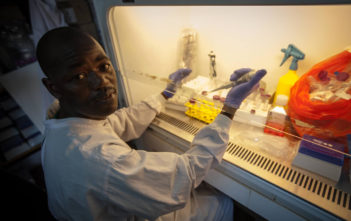
An international team led by the WHO has shown the ‘rVSV-ZEBOV’ vaccine produced by Merck can protect both individuals and a whole population from Ebola.
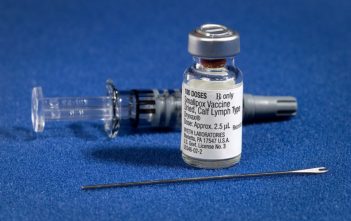
Most children in sub-Saharan Africa are today entitled to vaccines against 10 different diseases. While this is notably fewer than in high-income countries – British children are vaccinated against 13 diseases, for example – substantial progress has been made in the past few decades in protecting children in the developing world.
Despite the official retraction of the 1998 Lancet study that suggested a connection between vaccines and autism, as of 2010, 1 in 4 U.S. parents still believed that vaccines cause autism.
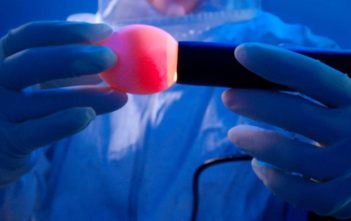
Developing a vaccine against any illness is difficult and time-consuming, but the need for rapid vaccine production becomes even more important against emerging infectious diseases like H1N1 flu. One of the biggest hurdles in creating an influenza vaccine has to do with the virus itself. “In conventional vaccine-making, you need the actual virus that causes the disease,” says Phil Dormitzer, who leads a team of vaccine researchers at Novartis. “The bottleneck has been for a vaccine manufacturer to get its hands on a suitable vaccine virus.”