
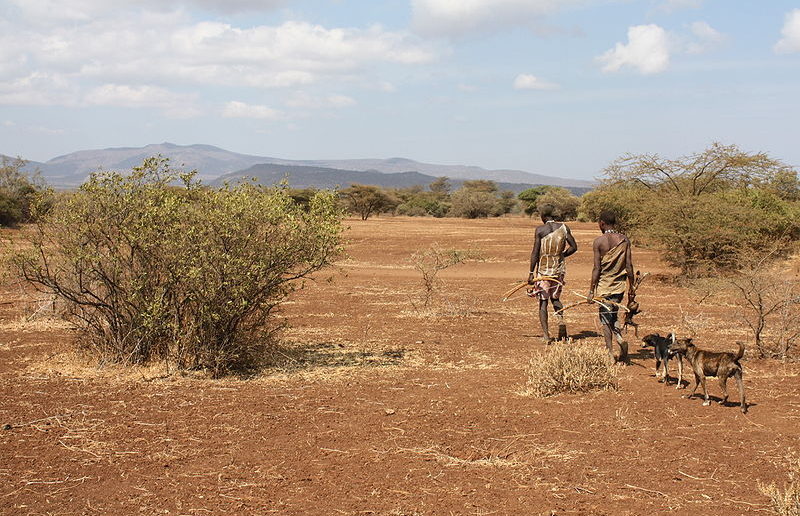
Hadza hunters. Photograph by Andreas Lederer
Quite by accident last week, I came across something, an ethnographic detail really, that captured my imagination, and that has clearly delighted and puzzled anthropologists and even contributed to a new theory of human evolution. The detail concerned the Hadza, 1000 or so modern hunter-gatherers who speak an ancient click language and who live in the woodlands around Lake Eyasi, Tanzania, not far from Olduvai Gorge.
The Hadza, as I discovered, prize honey above all else in their diet. Hadza mothers wean their young on liquid honey, and during the wet season, particularly the months of February and April, Hadza families gorge for weeks on its sticky sweetness. The men possess an expert knowledge of bees and bee behavior, giving the honeys produced by different species different names. Those who forage for honey figure prominently in Hadza mythology.
And there is indeed something almost magical about the way that Hadza collect honey.

Greater honeyguide. Photograph by Jerry Oldenettel
The Hadzas’ favorite type of honey, ba’alako, comes from the hives of the Apis unicolor adansonii, an aggressive species that frequently builds near the top of tall baobab trees. To gather it, the men pound wooden pegs into the tree trunk and climb with burning brush in their hands to smoke out the bees—a dangerous undertaking. One slip can lead to death. When the smoke has finally sedated the bees, the men steal the honey combs and reward the honeyguide with large chunks of beeswax.
Why is honey so crucial to the Hadza? In a recent paper, Alyssa Crittenden, an anthropologist and behavioral ecologist, at the University of Nevada, points out that wild honey is one of nature’s most energy-rich foods. It is 80 to 95 percent sugar and, if left unprocessed, contains both protein and fat from bits of bee larvae. As a rule, hunter-gatherers struggle to find calories: a scoop of honey supplies a huge hit.
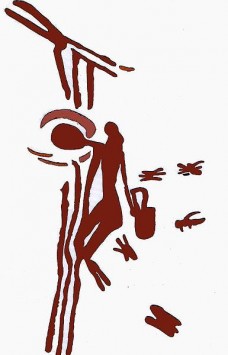
Drawing of a painting from Cueva de la Arana, Utilasateur: Achillea
Last year, Crittenden proposed an intriguing new interpretation for the world’s earliest known stone tools—sharp flakes found in an excavation in Ethiopia and dated to some 2.5 million years ago. Crittenden thinks such stone tools could have been knapped by ancient honey collectors who needed sharp, strong implements to split open beehives. Armed with such tools, she suggests, our hominin ancestors may have dined extensively for the first time on energy-rich honey, a food that may have fueled the evolution of our large, metabolically costly brains. The earliest member of our genus, Homo, emerged some 1.5 to 2 million years ago, equipped with brains significantly larger than their predecessors. Moreover, they possessed smaller molars, suggesting that they were dining on an easily consumed food. Honey.
Did humans evolve from an insatiable desire for calories? Well worth thinking about, I’d say.