


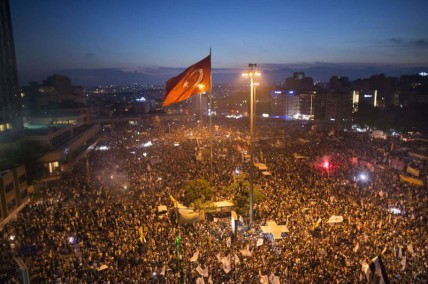
Taksim Gezi Park during 2013 protests. Photograph by Fleshstorm
I met a girl on the bus to campus. We had twenty minutes left of the journey and she wanted to practice her English. She was a student and had been in Gezi over the summer. Her face lit up as she told me how exciting it had been. How they laughed as they ran from the police and their tear gas.
“You were laughing?”
“Yeah, of course. What else could we do?”
“What’s changed since then?”
“Nothing.”
“Do you think there will be another Gezi?”
“No, I don’t think so. Too many people died.”
The conversation was difficult to restart after that.
At the campus I met some translation students who were eager to help me with some graffitti and poster’s I’d seen around Istanbul.They tried to smother sniggers and giggles as I showed them my photocopies. The students quickly split into groups and started working.
The first group, they were looking at a poster which had been placed on a fountain. It read “Bir agaca daha dokunursan fiskiye olur” – they were laughing out loud at this one.
“Okay, explain it to me – I don’t get the joke.”
“It says, “we are warning you. If you cut down one more tree, the “faintain” dies!” During the Gezi Protests, authorities claimed that the protestors were vandalising the public property. The Mayor of Ankara, Melih Gokcek tweeted that the water fountain in front of the Mayor’s office was damaged by the protestors and asked them to take responsibility. But he didn’t spell fountain right.”
“So it’s ironic, the government don’t want their public fountains damaged, but were fine about the people.”
The next group were looking at a meme. “Biber gazina ne iyi gelir??” With a woman screaming “Sirkeee” and an equally determined looking chap saying “Limooooon!”
“Okay,” I asked, “what’s going on here?”
“These two are a husband and wife from an old Turkish movie. It’s a comedy. In the movie they constantly fight about how to make pickle. They even get a divorce about it. The question at the top is asking “what is the best remedy for the pepper spray?” The husband is saying ‘lemon’ and the wife, ‘vinegar’. During the Gezi Protests, the police were using the pepper spray and everyone had a different solution for the pain in the eyes.” Hm, hilarious.
The next piece was relatively self-explanatory. It was a street sign from Ankara, it used to say “Tunalihilmi Caddesi” – Caddesi means street, and it now read “Tomalihilmi’ – a reference to the street was inhabited by TOMA’s. A TOMA is an ‘Intervention Vehicle to Public Events”, a polite name for an impolite vehicle, equipped with high pressure water hoses.
Earlier that day I had seen an article about the campaign to re-design the TOMA. Gezi Resistance activists found about the government’s plans to expand the Turkish constabulary’s TOMA collection and launched their own campaign asking people to design their own TOMA’s. Their website showed some of the suggestions, let’s just say photoshop had been used, extensively.
The next piece we looked at was some words spray painted on the ground. The students told me it was meant to be read like a phone message, “Imdat Polis! – nyse sn msglsn glba ..s …s” translation: “Help, Police! Oh! I guess u r busy … :S :S”. I didn’t need an explanation but I got one anyway, “During Gezi, the police were busy attacking people, too busy to answer the phone when the people needed them.” I had to admit that I’d never sent a text like that.
I moved onto the next group who were looking at what looked like a street sign that had been turned into the kind of thing you make at primary school with words coming out of the existing letters in the word.
“You see here it says “Her Yer Taksim Her Yer Direnis” – Everywhere is Taksim, Everywhere is in uprising. And here is the three names of a 19 year old guy, Ali Ismail Korkmaz, he was killed by the police.”
The next piece to be translated was a picture of some graffiti. Three guys were sitting on a wall which read “Alkolu yasakladin millet aildi”.
“Is this about Gezi?”
“Not really. It means, ‘you banned alcohol, now everyone has sobered up!”, it’s proudly stating that the citizens are becoming more and more aware of the Prime Minister’s true intentions.” A few months ago Prime Minister Erdogan announced that it would be illegal to sell alcohol after 10pm. I didn’t ask what the students to expand on Erdogan’s true intentions.
The next group had some words painted on a wall, “ne yazacagini bulamadim ama anarsi filan iste” . “Well this is hard to explain, ‘I couldn’t find anything to say but things like Anarchy and so on.” This guy doesn’t have anything to say or everything he has to say has already been said. However, he wants to be part of the group, part of the protest.” I thought that was rather poignant.
My translations were courtesy of one of Istanbul’s private universities. The students who attend all have smart phones and fashionable clothes, their Audis and BMW’s filled the car park. They all seemed proudly financially secure. But they are also furious.
When the translations were done the students were keen to tell me about their experiences from the summer. Most had been out of the city, in their hometowns watching events unfold on the lesser known news programmes and keeping updated on Facebook. The mainstream news was busy airing a penguin documentary when protesters were cleared out of Gezi Park. None of the students seemed to trust the big news agencies here in Turkey.
“What was it like?”
“Everywhere was Taksim! Every night at nine o’clock the streets would start flashing and the noise of pots and pans filled the streets. The kids were all loving it, to them it was a game, turning the lights on and off.” This went on for three weeks.
“Erdogan was making speeches saying that he alone was keeping people in their homes.”
“Why is that? Which people?” I didn’t understand.
“Erdogan had ordered his people, his supporters to stay at home, He said it was because of him that they weren’t out on the streets fighting with protesters.” To me that sounded like he was threatening Turkey with a type of civil war. But maybe I misinterpreted.
I had heard some stories about things that happened at Gezi. Things which had shocked me, things that didn’t shock these students. These are students are immune to surprises.
I told them a story I had heard about how the protestors were infiltrated by pro-Government spies, I asked the students whether they thought it was likely. I was referring to a rumour that men, pretending to be Kurdish nationalists, had started throwing rocks at the police. Nobody knew who they were and I had been told that they might have been undercover police.
“Ya, ya – my friend, he supports one of the Istanbul teams, Fenerbahce and they hate this other team, Galatasaray. Like they really hate each other. They always fighting and it’s dangerous to walk alone with a shirt y’know. But they went to the protests and these guys wearing different shirts were holding hands and protecting the protesters. But then the police, they put on the shirts and joined the crowd and started fights with the guys.”
One girl who was in Istanbul over the summer tried to get the ferry from the Asian side of Istanbul over to the European side where the protests were. “But they stopped the boats. The only boats were to the islands where there was an AKP rally.”
“Who were they? Who stopped the boats?”
“Ah, I don’t know. They just stopped the boats.”
Another girl chirped in at this point, “yeah, and they pay the people. They get a text on their phones saying come here, we will pay you 100 lira. And then there are all these pictures of big crowds infront of Erdogan.”
There is no way for me to verify these claims. I have no evidence, and I doubt the students were always talking from personal experience, but I don’t think that’s the point. The point is that these young people weren’t surprised by the stories of violence and police brutality that were coming out of their mouths. They knew they weren’t normal. They were very much ashamed of how their democratic and supposedly secular government was behaving, but they could laugh about it. “Yeah, of course. What else could we do?”




.jpg)