
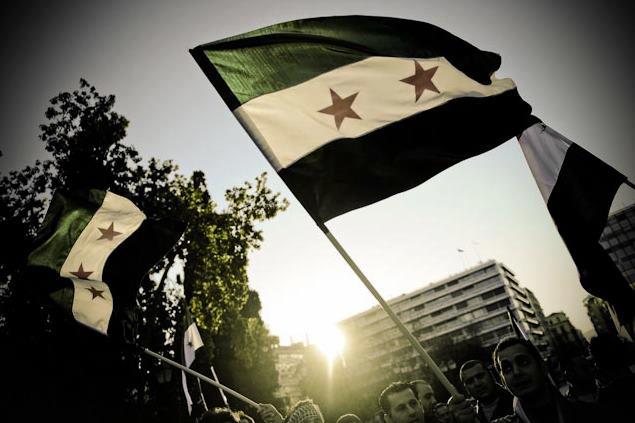
Photograph courtesy of Syria Revolution in Photos
Foreign secretary William Hague has urged Syrian rebels not to boycott the upcoming Geneva II talks in order to find some pathway to peace in the war-torn country.
The Syrian National Coalition of Opposition Forces (SOC) has said that they are unwilling to hold meetings with representatives of Bashar al-Assad’s government, but diplomats from around the world have urged the group to unite the rebel factions and negotiate in order to exclude extremism from a post-war Syria.
Hague was speaking at a London meeting of the “Friends of Syria” group, where the foreign ministers of eleven countries including Britain, Egypt, France, Germany, Italy, Jordan, Qatar, Saudi Arabia, Turkey, the United Arab Emirates and the United States are attempting to bring the SOC to the negotiating table. He admitted that as the civil war has continued, more rebels have moved to support the more extremist militant groups, partly because of their better funding and resultant military successes.
There are wide divisions between the various groups fighting against Assad’s army in the ongoing civil war, with the loosely organised Free Syrian Army (FSA) long starved of weapons and support in contrast to the Islamic fundamentalist groups such as Jabhat al-Nusra and Islamic State of Iraq and al-Sham (ISIS). ISIS in particular is not only fighting against Assad’s military, but often also against the FSA in its attempts to create a fundamentalist Islamic state.
The majority of groups that fight under the FSA banner support the SOC, and the group are recognised as the sole representative of the Syrian people by a number of governments around the world including the UK, and they hold Syria’s seat in the Arab League.
The upcoming Geneva II talks are aimed at bringing the Syrian conflict to an end, but Syria’s main internation ally, Iran, currently has no role in the discussions. Iran is believed to be offering Assad financial and military support, as well as funding the Lebanese militant group Hezbollah which has been fighting alongside Assad’s military inside Syria. Hague has said that he was trying to improve relations with Iran to encourage them to play a “more constructive role” in the talks, but that any such inclusion would require Iran to back a “transitional government” in Syria made up of rebel and regime figures.
Another major obstacle in the talks is that Assad has dismissed the idea of standing down as president, and has told Lebanese media that he intended to run for re-election in the future. After years of fighting and more than 100,000 casualties, however, the rebels would never concede on Assad maintaining his grip on power.