
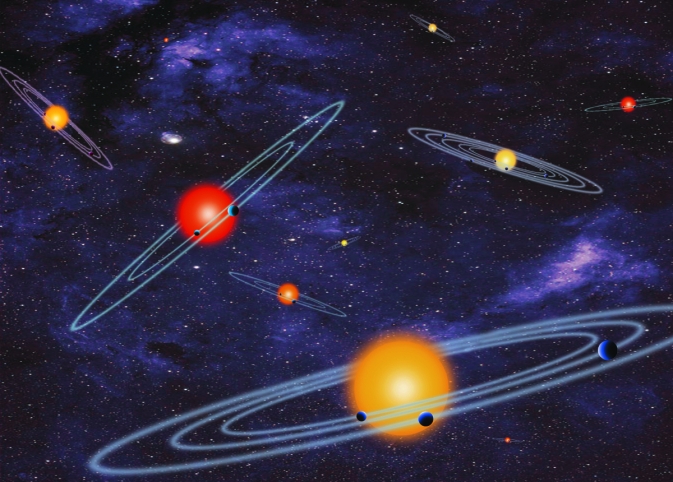
Artist concept of multiple-transiting planet systems. NASA
The team of Nasa scientists tasked with sorting through the vast amounts of data produced by Nasa’s Kepler telescope have identified 715 previously unknown planets beyond our solar system.
These planets orbit 315 different stars, with most of the newly discovered planets found to be part of multi-planet systems.
95% of planets are also less than four times the size of earth, but four planets are less than 2.5 times the size of earth and orbit their stars in the so-called “goldilocks zone”, where the planet would neither be tool hot nor too cold for liquid water.
One of these new habitable zone planets, called Kepler-296f, is twice the size of earth and orbits a star half the size and 5% as bright as our sun. However, scientists do not know whether the planet is a gaseous world, with a thick hydrogen-helium envelope, or it is a water world surrounded by a deep ocean.
Jason Rowe, research scientist at the SETI Institute in Mountain View, Calif., and co-leader of the research said:
“From this study we learn planets in these multi-systems are small and their orbits are flat and circular — resembling pancakes — not your classical view of an atom. The more we explore the more we find familiar traces of ourselves amongst the stars that remind us of home.”
John Grunsfeld, associate administrator for NASA’s Science Mission Directorate in Washington said:
“The Kepler team continues to amaze and excite us with their planet hunting results…That these new planets and solar systems look somewhat like our own, portends a great future when we have the James Webb Space Telescope in space to characterize the new worlds.”
We have now confirmed the discovery of nearly 1,700 planets outside our solar system, with Kepler, which was launched in 2009, responsible for 961 of those discoveries.