
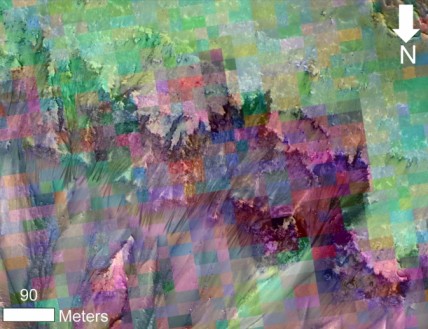
This image combines a photograph of seasonal dark flows on a Martian slope with a grid of colors based on data collected by a mineral-mapping spectrometer observing the same area. NASA/JPL-Caltech/UA/JHU-APL
NASA’s Mars-orbiting spacecraft and found the “strongest indication” that liquid water may exist today on the Red Planet.
Images sent back from the spacecraft show dark, finger-like markings, called “recurring slope lineae” (RSL), that flow down some slopes on the Martian surface when temperatures rise. New corroborating information includes seasonal changes in iron minerals on the same slopes and a survey of ground temperatures and other traits at active sites.
This information suggests that there may be seasonal flows of brines with an iron-mineral antifreeze, such as ferric sulfate.
Lujendra Ojha, a graduate student at the Georgia Institute of Technology, Atlanta, and lead author of two new reports about these flows said:
“We still don’t have a smoking gun for existence of water in RSL, although we’re not sure how this process would take place without water”
Ojha and Georgia Tech assistant professor James Wray did not find any spectral signature tied to water or salts when recently searching for minerals that RSL might leave in their wake, but they did find distinct and consistent spectral signatures of ferric and ferrous minerals at most of the sites. These iron-bearing minerals were more abundant or featured distinct grain sizes in RSL-related materials as compared to non-RSL slopes. These results are in a paper published in the journal Geophysical Research Letters.
Ojha said:
“Just like the RSL themselves, the strength of the spectral signatures varies according to the seasons. They’re stronger when it’s warmer and less significant when it’s colder.”
One possible explanation for these changes is a sorting of grain sizes, such as removal of fine dust from the surface, which could result from either a wet process or dry one. Two other possible explanations are an increase in the more-oxidized (ferric) component of the minerals, or an overall darkening due to moisture. Either of these would point to water, even though no water was directly detected.
The spectral observations might miss the presence of water, because the dark flows are much narrower than the area of ground sampled with each CRISM reading. Also, the orbital observations have been made only in afternoons and could miss morning moisture.
The leading hypothesis for these features is the flow of near-surface water, kept liquid by salts depressing the freezing point of pure water.
Mars Reconnaissance Orbiter Project Scientist Richard Zurek, of NASA’s Jet Propulsion Laboratory, Pasadena, California, said:
“The flow of water, even briny water, anywhere on Mars today would be a major discovery, impacting our understanding of present climate change on Mars and possibly indicating potential habitats for life near the surface on modern Mars”
In related research, reported in a paper to be published by the journal Icarus next month, the Georgia Tech scientists and colleagues at the University of Arizona; U.S. Geological Survey, Flagstaff, Arizona; and Polish Academy of Sciences, Warsaw, used the Mars Reconnaissance Orbiter and NASA’s Mars Odyssey orbiter to look for patterns in where and when the dark seasonal flows exist on Mars. Their results indicate that many sites with slopes, latitudes and temperatures matching known RSL sites do not have any evident RSL.
They hunted for areas that were ideal locations for RSL formation: areas near the southern mid-latitudes on rocky cliffs. They found 200, but barely any of them had RSL.
Ojha said:
“Only 13 of the 200 locations had confirmed RSL. The fact that RSL occur in a few sites and not others indicates additional unknown factors such as availability of water or salts may play a crucial role in RSL formation.”
They compared new observations with images from previous years, revealing that RSL are much more abundant some years than others.