
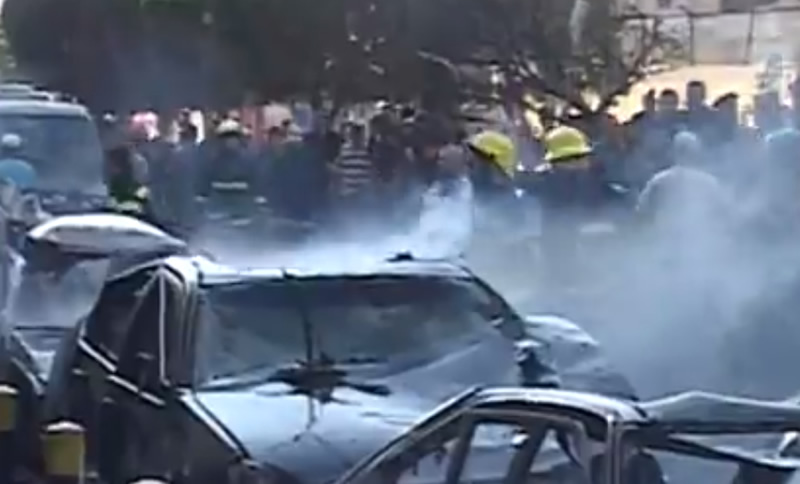
At least 22 people, including the Iranian cultural attaché Ebrahim Ansari, are reported to have been killed in two blasts that targeted the Iranian embassy in Beirut.
The Abdullah Azzam Brigades, a Sunni jihadist group linked to al-Qaeda, has claimed responsibility for the two bombs, which witnesses said were caused by a suicide bomber and a car bomb, and CCTV footage reportedly supporting these claims.
Security forces and emergency rescue teams are still trying to find survivors and clear the rubble, with Lebanese television showing pictures of the aftermath with burning cars and bodies lying in the street.
Iran quickly blamed Israel for the attack, an accusation that Israel quickly denied.
Syria has condemned the attack on one of its main allies. Iran has financial support, military equipment, and personnel to aid the regime of Bashar al-Assad since the outbreak of the conflict. They are also the main backers of the Lebanon-based Shia militant group Hezbollah, which has been fighting alongside regime forces in the ongoing civil war in Syria.
Whilst there have been a number of recent skirmishes within Lebanon, the increasingly sectarian fighting has remained mostly within Syrian borders to date. However, if this attack is confirmed as a suicide bomber, this could be a statement of intent from Sunni jihadists that Iranian installations outside of Syria have become legitimate targets and Lebanon could become a battlefield.
Many have feared the sectarian violence from Syria spilling over into Lebanon, a country where tensions between Shias, Sunnis, and Christians remains high after the 15-year civil war that lasted between 1975 and 1990 in which an estimated 120,000 people were killed. Lebanon has kept an uneasy truce between the parties for 24 years, but as the war in Syria has raged on and become more of a sectarian conflict than a fight for freedom, attacks may become more frequent on Lebanese soil, escalating its internal tensions further.