

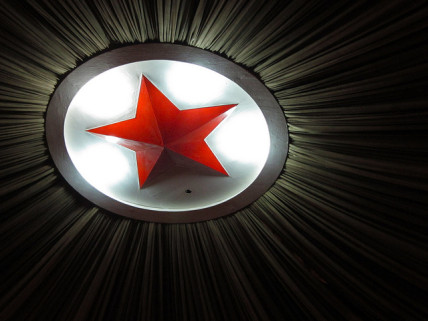
Star of the DPRK (North Korea). Photograph by John Pavelka
President Obama stated in a 2009 speech on North Korea that “rules must be binding, violations must be punished, words must mean something.” Now, approaching four years later little progress has been made. So, why is this? Much is said about the DPRK’s nuclear threat, but the reasons for the inimitable global dilemma are down to a series of other factors. A layered set of strategic characteristics covering the realms of defence, culture, and the economy in tandem with their nuclear potential have merged to form the most thorny of problems for the respective regional and world powers most concerned by the rogue state.
On a social and cultural front the North’s sustained ability to shield itself and its people from the rest of the planet is extraordinary. The leadership has learnt from the downfall of other communist autarkies. Particularly the cases in Eastern Europe economic revival was sought by embracing measures which increased integration and contact with the outside world. For Pyongyang, concepts like reform and opening-up (in the words of a 1998 KCNA press release) “are a honey coated poison”.
What will worry the United States and others is that the effectiveness of North Korea’s disconnect from the outside world means that any Kennanist hopes of prompting citizen discontent over domestic conditions is unlikely to occur in the short or medium term. This, along with the cult of the ‘great parental leader’ means policy directed toward encouraging a rebellion from within is not a tack that is likely to solve the problem any time soon. To compound the issue, a waiting game could also mean Pyongyang spending another decade or more harming its people, attacking its neighbours and expanding its nuclear stockpile. Indeed, military experts agree that the North may only be a few years away from building a nuclear warhead capable of reaching the US mainland.
The unsteady and volatile arrangement of the North Korean economic set-up makes interference from foreign bodies especially risky. It is an aspect of the North’s deterrent toward those who might seek to intervene. Neighbours like China, South Korea and Japan are particularly fearful that the regime’s collapse would cause uncontrollable disorder. For example, the upending of the country’s food supply network could likely spark a humanitarian crisis and see refugees stream across borders. In turn such an uncontrolled breach of the North Korean margins could see the unfurling of its nuclear network. The dismal risk of nuclear materials reaching the black market would be greatly increased, as would the chances of international forces, particularly those of China and the United States coming face to face in the scramble to secure the region. Other problems like having to repair the country’s derelict infrastructure and manage the recovery of a population riddled by deprivation and malnutrition put off the UN from attempting to implement the kind of crippling economic sanctions that could see the country collapse.
In the short term China has similar reasons for not involving itself with attempts at a dissemblance of the Kim tyranny Beijing have effectively taken over the role the Soviet Union played before the Cold War, and acts as by far North Korea’s largest trading partner at a significant fiscal deficit to themselves. A unified Korea would likely mean a Korea re-structured in line with westernised democratic and economic norms: a development the CPC would find principally undesirable.
North Korea’s own collapse carries with it a spectre that is in the eyes of most international actors even worse than the abusive leadership that has held court there since the fall of the Berlin Wall. Presently, the only form of attenuation the major powers feel they can hope for is slow reform to change the nature of the regime in the North. China, best placed to provoke reforms having spent decades supporting Pyongyang, is caught between opposing motives – both supporting UN sanctions against the DPRK whilst not really wishing to enforce them. Events over the last few days have shown that even with a new leader, the likelihood of a mellowing in policy from the North looks increasingly faint; as does the chance of international action varying from the tack it has taken over the past twenty years.
Forcible attempts at regime change are just not thinkable bearing in mind the potential costs of a military response from the North upon the South. Leaders in Seoul, Washington and Beijing will continue to try and delay the regime’s fall whilst taking action aimed at making such a demise less disastrous if and when it were to eventually occur. Efforts to attenuate the regime’s power will be slow. The time it will take will come at the cost of the North Korean people and will enable further development and proliferation of nuclear technology. These are the unpleasant truths attached to the prolongation of the regime in the North. The UN have on their hands a most unsavoury balancing act, but it is very hard to see a third way. Thus, despite further bellicose behaviour– including threatening the US with a pre-emptive strike – the limit to the world’s tolerance of the North has not been reached; nor has the end of the Kim tyranny.
Written by George Neal