
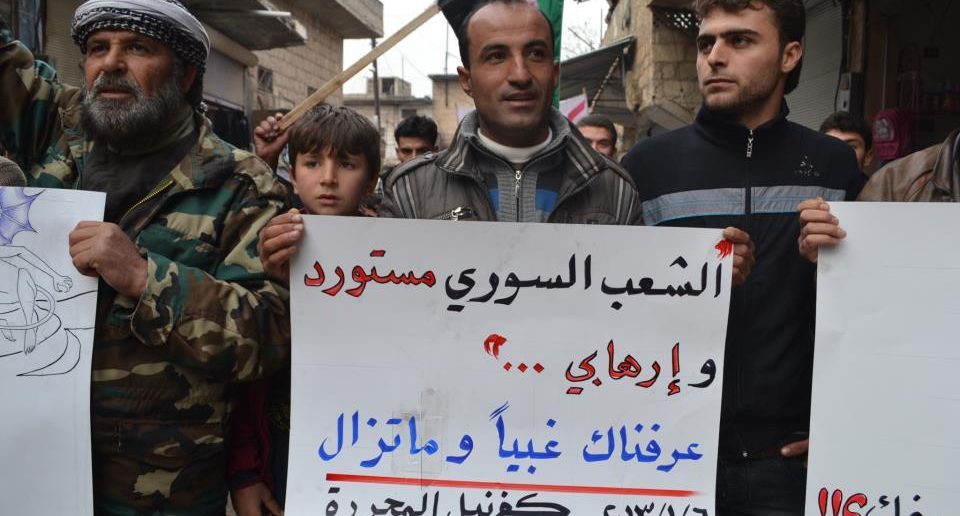
Reaction to Assad’s speech in Kafranbel, Syria. Photograph courtesy of NMSyria
Millions of Syrians are using social media tools such as Facebook, Twitter, YouTube and Skype to disseminate and discuss the conflict. Each week our Mohammed Sergie monitors the online conversation in English and Arabic, pulling out the highlights in a feature called the Social Media Buzz.
President Bashar Al Assad gave a rare speech on Sunday, his first since June, igniting Facebook and Twitter discussions that provided a jolt to both his supporters and opponents. Assad reiterated his argument that there is no revolution in Syria and that those seeking his ouster are criminals and terrorists working for foreign enemies. He laid out a peace plan that echoed his stance for the past 21 months, refusing to engage the armed rebels and functionally insisting on staying in power.
The online discussion followed a predictable flow. Assad opponents dismissed the speech, pointing out that nothing new was said, while Assad supporters were invigorated, gleeful at the defiance of their embattled president.
Homs after the #Assadspeech pic.twitter.com/u9zVKY2M
— Si Ri Un (@syrian_army_) January 6, 2013
Kafranbel's reaction to the #AssadSpeech. On point, as always. pic.twitter.com/0qT4YBmn
— نور (@NMSyria) January 6, 2013
Although the fate of Assad and his family’s decades-long rule remains the core demand at the heart of the Syrian conflict, the debate in Syria has touched on broader issues — none more sensitive and potentially deadly than the sectarian enmity brewing in the country. Subhi Hadidi, a prominent Syrian writer for the London-based daily Alquds Alarabi, sparked some testy exchanges this week.
It began when Hadidi said that Alawites should examine the roots of the violent behavior of some in their sects, a comment that was a reaction to the apparently endless stream of videos showing Syrian soldiers taunting and killing unarmed prisoners.
التعفف عن تسمية الانتماء الطائفي لهؤلاء القتلة الهمج، هو دفن عامد للرأس في الرمال؛ ما هكذا تُعالج ندوب الأوطان! http://t.co/eMqEDS4j #Syria
— Subhi Hadidi (@SubhiHadidi) January 1, 2013
Many took offense to his statement, including Samar Yazbek, an Alawite writer who supports the revolution, and labeled him as sectarian. Yazbek asked why people fell silent after it became known that one of the alleged soldiers was Sunni. His response tries to clear up the point but its aggressiveness doesn’t seem to have been effective.
يمكن، طبعاً، لأي مواطن، سنّي أو درزي، أن يعرّي جذور العنف لدى بعض أبناء طائفته؛ أو سواها. فهل معيب (وطائفي!) أن يفعل هذا مواطن علوي؟ #Syria
— Subhi Hadidi (@SubhiHadidi) January 5, 2013
Asaad Abu Khalil, author of the Angry Arab blog and a fierce opponent of the Syrian revolution, linked to Hadidi’s tweetsand alerted readers to their “sectarian quality.”
The unmistakable signs of Islamism continue in Aleppo. The image below shows rebels emptying liquor bottles into a drain, a picture that has many liberal supporters of the revolution concerned that they may not be able to drink alcohol in a post-Assad Syria.
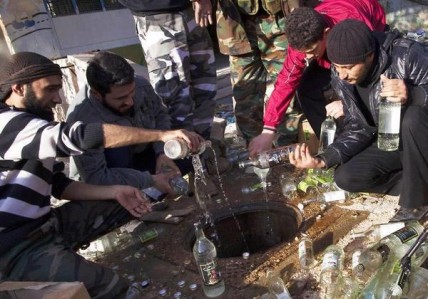
Islamists pour alcohol down the drain in Aleppo
Written by Mohammed Sergie