Dead of Night: Tell us a story
“Bolstered by some splendid acting, Dead of Night makes a very frightening movie. The stories are as varied as they are entrancing”
Stephen Townsend, Edinburgh University Film Society
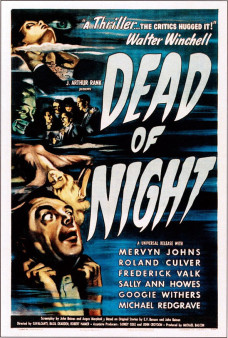
Ghost stories and the telling thereof, though capable of chilling the marrow during any season of the year, have a particular affiliation with Christmas. Gatherings round the drawing room fire as the shadows grow longer and the nights draw in lend themselves perfectly to the recounting of stories of the supernatural, uncanny and inexplicable. It is this premise around which is built a little seen film which, though eschewing the modern trend for in-your-face viscerals, still manages to instil seeping dread and horror in the viewer. It is a testament to the craft of classic British cinema that Dead of Night (1945), a slightly musty film which is by all intents creaky and stilted, still continually outranks all others in the genre more than sixty five years after its first release.
Produced by Ealing Studios, better known as purveyors of genteel family films starring comedy stalwarts like George Formby and Will Hay, Dead of Night was a break from the norm for the British production company. That it was, and still is, considered a masterpiece of subtle, understated menace, proves true the old adage that less is more. In fact it is probably this approach which has leant it its timeless quality and ability to scare viewers no matter who or where they are.
So, what is the secret of this film’s longevity? The atmospheric placement of the connecting story at a weekend party in a beautiful country-house nestled deep in England’s home-counties? Its sense of period style – the past is always a much more romantic setting for stories of the supernatural. Or simply the fact that the five short tales which make up the film, except perhaps that of the ventriloquist and his demon dummy, are all believable. Though perhaps slightly farfetched in places, the premises behind the stories are not beyond the bounds of possibility, and as such have an universal appeal to audiences no matter their age or the period in which they live, which is the secret of all classic ghost stories.
Dead of Night: Synopsis
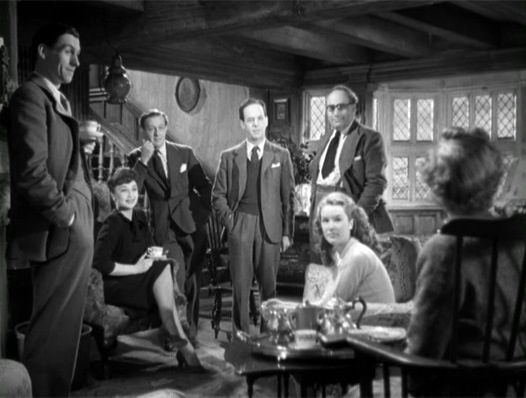
 Architect Walter Craig, has been invited by Eliot Foley to stay at his country-house in order to discuss plans for a proposed extension. Staying at the house with Eliot and his mother are several friends who have come for a weekend house-party. Though never having visited the house, Walter is overcome after entering by a sense of unease which only increases as he is shown into the sitting-room where the varied guests are enjoying afternoon tea round a roaring log fire. Offered refreshment by Mrs Foley, Walter begins to explain to the assembled party that he has visited the house regularly in a recurring nightmare. Each time he awakes just before the end, though he is convinced if he didn’t it would climax in certain disaster.
Present is a psychiatrist, Dr Van Straaten, who is sceptical about what he sees as hallucinations on the part of Walter. Then, one by one, each guest assures Walter that they believe him as they too have had peculiar experiences which have left them with feelings of dread that have continued to haunt them subconsciously. Each of their stories is bizarre, uncanny and, most disturbingly, laced with an air of believable authenticity.
One guest Hugh Grainger, a famous racing driver, was hurt some time back in a car accident. While convalescing in hospital Hugh had a dream in which he encountered a horse drawn hearse, the driver of which would beckon him into it. Several weeks passed and Hugh was ready to go home. The morning he left hospital he was boarding a bus when he received a shock – the conductor was the hearse driver from his dream. Despite the conductor’s encouragement for him to board, Hugh held back – a lucky move on his part. Imagine his horror as he watched the bus skid whilst crossing a bridge further down the road, and crash into the river below killing all on board!
Sally O’Hara is the youngest guest, but has a ghostly encounter to share which is equally upsetting. Several years before she was staying with family friends at their rambling country house, where they were holding a Christmas party for their children and other local kids. Being the eldest Sally felt out of things but agreed to join in a game of Sardines. Searching for a place to hide from the others Sally discovered a distressed young boy in a nursery room high up in the attics of the house. Calming the child and putting him to bed Sally raced downstairs where she told the rest of the partygoers about the small boy she had just met. Sally was understandably shocked when told that there was no-one of her description staying at the house, but that it sounded like that of a child who was murdered in the attic nursery by his jealous sister many years before.
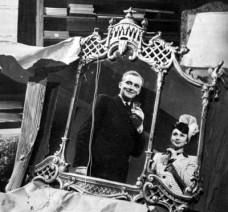
Googie Withers as Joan and Ralph Michael Peter Cortland
Convinced that something disastrous will befall him if he stays any longer Walter gets ready to leave. However before he can go his host tells him that he too knows of a supernatural incident which befell two friends of his. George Parratt and Larry Potter, though best friends, were deadly rivals in two areas – golf and the love of a girl called Mary Lee. Unable to agree who should win Mary’s hand the men played a round of golf to decide – the winner would marry Mary, the looser disappear for good. The game took place and the two men were neck and neck until the last hole when, with a bit of underhand cheating George won and a distraught Larry committed suicide by walking into the lake at the centre of the golf course. But true to the old adage of your sins finding you out, Larry refused to rest in peace. He returned to haunt George but suddenly found himself unable to leave the mortal plain until a twist of fate reversed their places with George being whisked beyond the grave whilst Larry was left behind with Mary.
As the company prepare for dinner attention turns to Dr Van Straaten. Surely in his work as a psychiatrist he had encountered cases inexplicable in human terms? The doctor admits that a few years previously he had been asked for his professional advice on a famous criminal case which did indeed defy regular means of explanation. Maxwell Frere, a well-known ventriloquist, had a successful stage act with a dummy called Hugo. So popular was his act that the lines between reality and make-believe became blurred, with Maxwell convinced that Hugo had taken on a life of his own. Maxwell’s delusions came to a head when he was arrested and charged with the attempted murder of Sylvester Kee, a rival entertainer who he believed was trying to steal Hugo. But who committed the crime – the unhinged Maxwell or his disturbingly lifelike alter-ego Hugo?
On finishing his story Van Straaten finds himself alone in the sitting-room with Walter. Suddenly Walter gets up and walks towards the doctor. He has seen how his dream finishes – a realisation with devastating results for the doctor. But is this reality, or simply part of Walter’s nightmare…
Dead of Night: Production
Truth be told it is unlikely that Dead of Night could be made today. The classic chiller from that most British of film studios Ealing, was very much a product of its time. In this modern age where films increasingly depend on heightened visuals to create horror, those which play on atmosphere and suggestion are few and far between. However Dead of Night’s black and white visuals and fusty appearance only seem to compliment the film’s supernatural subject matter.
Founded in 1902 by film maker and entrepreneur Will Barker, Ealing Studios would become one of the most famous British production companies in the world rivalling Hammer and and Carry On films in popularity. Best know for the string of comedies they made in the late 1940’s and 1950’s, including Kind Hearts and Coronets (1949) and The Lady Killers (1955), it was Dead of Night which would prove one of the studio’s most influential and revered films and their only sojourn into straight horror, albeit with a liberal dose of black humour.
Filmed at the studios West London facilities, the production also made use of various outdoor locations in nearby Buckinghamshire, including the village of Turville and Stoke Poges Golf Course which doubled for St Andrews’ Royal and Ancient Golf Course in the golfing story. That much of the film’s action is interior bound if anything adds to its richness overall as this is a film which depends as much on characterisation and storyline as on standard horror film shocks. The strength of the individual stories (even the golf one, clearly included to lighten the film’s tone, is cleverly and adroitly handled) is hardly suprising, being penned as they were by, amongst others, those masters of the uncanny H. G. Wells and E. F. Benson.
In front of the camera a host of British stars including Ealing regulars Googie Withers and Miles Malleson as the prophetic hearse driver / bus conductor as well as the revered Michael Redgrave, leant the film gravitas, whilst the presence of the relatively unknown child actress Sally Ann Howes (who would later be immortalised as Truly Scrumptious in Chitty Chitty Bang Bang (1968)) was a breath of fresh air amongst a cast of older and more established names.
The overriding sense of quality which permeates every aspect of the film was due equally to those involved behind the scenes. Directed by four different men, including Alberto Cavalcanti and Charles Crichton, their different styles though bringing a distinct flavour to each segment, blend seamlessly when the film is viewed as a whole. Add to this Georges Auric’s discordant music played over the film’s opening credits and a splendid juxtaposition of minimalist metropolitanism and country-house decadency in Michael Relph’s art direction and the perfect tone is set for the horrors which await the viewer.
Dead of Night’s autumn release date of 4th September 1945 may seem more in keeping with the film’s subject matter than that of the rest of the world, including a summer release of 28th June the following year in the USA. However this, along with the film initially being released in the USA without both the ‘Christmas Party’ and the ‘Golf’ stories, which were edited out as they were considered to lengthen the film unnecessarily, did not stop it becoming one of horror’s most popular additions and a film which to this day regularly tops the favourite’s lists of both genre fans and filmmakers alike.
Written by Cleaver Patterson