
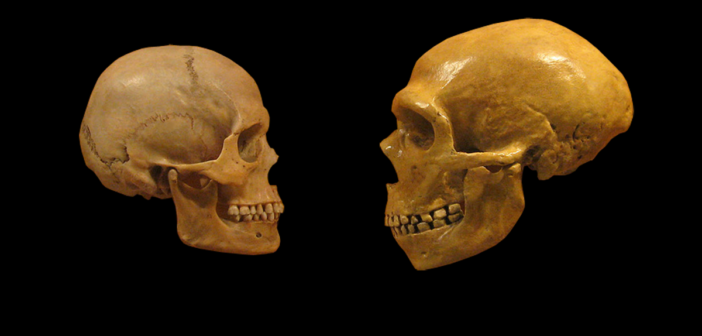

A new study has confirmed through statistical and genomic analysis that Neanderthals interbred with ancestors of Eurasians.
Published in the journal Genetics, the study shows that humans migrated out of Africa and then interbred with Neanderthals around Eurasia, rather than interbreeding in select pockets within Africa before migration.
In order to test both hypotheses, the researchers divided the genome into small blocks of equal length in order to infer genealogy, and determine with a high degree of certainty when interbreeding occurred.
Study co-author Konrad Lohse, a population geneticist at the University of Edinburgh, said
“Our approach can distinguish between two subtly different scenarios that could explain the genetic similarities shared by Neandertals and modern humans from Europe and Asia”
Confirming that Neanderthal interbred with human ancestors as they migrated into Eurasia brings into question the idea that human ancestors simply out-competed other hominids for resources to become the dominant species, as it is likely that some Neanderthals lived within human populations, making the intertwined evolution of the species even more complex.