
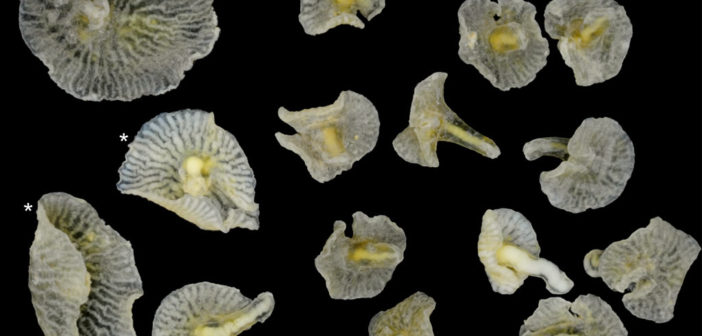
A strange mushroom-shaped deep sea animal found off the coast of Australia are unlike anything else known in the modern world and may be a new branch of life.
The unique creatures do not fit into any grouping or classification of animals currently alive, but have similarities with members of Ctenophora and Cnidaria phyla, and most closely resemble animals that lived 635 – 540 million years ago during the Ediacaran period, which has since long gone extinct.
A new genus, Dendrogramma, with two new species of multicellular animals, Dendrogramma enigmatica and Dendrogramma discoides, was first discovered 400 – 1,000 metres deep in the ocean off the coast of Tasmania in 1986. However the two species have only recently been classified by scientists from the University of Copenhagan in a paper published in the journal PLOS ONE.
The animals are only a couple of millimetres in size and have a unique non-symmetrical body plan, which means that they are not part of the Bilateria group, which includes a large number of animals including humans.
The multicellular organisms have a digestive opening at the base of their “stalk”, with a digestive canal leading up to the wider “cap”, and have a dense layer of gelatinous material between their skin and inner stomach cell layers.
Describing the discovery, one of the paper’s authors, Jørgen Olesen, commented:
“Two species are recognized and current evidence suggest that they represent an early branch on the tree of life, with similarities to the 600 mill old extinct Ediacara fauna.”