
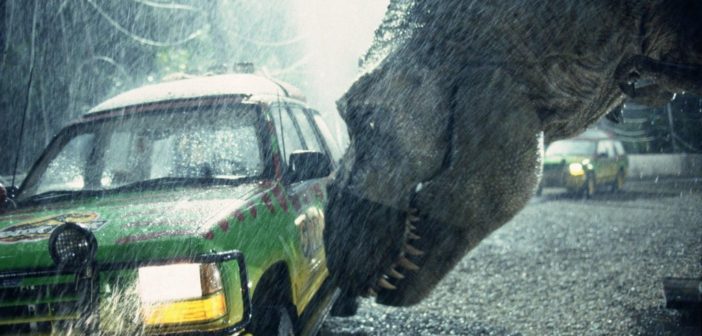

Still from the film Jurassic Park courtesy of Columbia Tristar
On the same day that the latest instalment of the Jurassic Park film series has been confirmed, a study published in the journal PLOS One has detailed experiments that seem to prove once and for all that dinosaurs will never again walk the Earth.
The 1993 film, based on a book by Michael Crichton, depicts a theme park island filled with dinosaurs, resurrected from ancient DNA extracted from fossilised mosquitoes trapped in amber.
In the early 1990s, several scientists announced they had extracted DNA from insects fossilised amber as long as 130 million years ago. Insects from this time in Earth’s history, the early Cretaceous period, would have flown among dinosaurs such as flying pterosaurs, swimming plesiosaurs, giant, long-necked sauropods, among the largest creatures ever on land, feathered birds and mammals.
This Lebanese amber was until recently the oldest in the world, older than the more common Dominican amber of around 16 million years ago, or the 49-million-year-old amber of the Baltic. Last year, tiny mites were found for the first time in amber dating from the Triassic period – 230 million years ago.
While the premise of the film – that dinosaur DNA could be extracted from the guts of a preserved mosquito that had recently dined on one – seems logical, the fragile nature of DNA and the huge expanse of time that has passed has led many experts to doubt those claims to have extracted DNA so old.
Dr David Penney, a palaeontologist and expert in amber-preserved spiders and insects at Manchester University, carried out experiments to try and confirm once and for all whether DNA could be extracted from creatures fossilised in amber. With Professor Terry Brown, an ancient DNA expert also at the University of Manchester, they used the latest “next generation” DNA extraction and sampling techniques to avoid DNA contamination.
“We used Manchester’s specialised, dedicated laboratories that are only used for analysing ancient DNA”, Penney said. “Any DNA traces will be be tiny pieces of ancient, fragmented material, so it’s important to avoid contamination with modern DNA.” The laboratories are sterilised, the air filtered, and scientists wear full-body decontamination suits.
The specimens from which scientists claimed to have successfully extracted DNA were of stingless bees, and Penney used examples of the same species. One was about 10,600 years old, the second was preserved just after World War 2 – only about 60 years ago. Both samples were in extracted from copal, the hardened form of tree sap that had encased the insects, but which had not fully fossilised into amber. Chemicals were used to dissolve away the copal before samples were taken from the captive creature inside.
The results were pretty conclusive: “In the oldest specimen we found no viable DNA,” Penney said. “In the newer sample we found various bacterial and other DNA, but nothing that was certifiably from the bee.”
Professor Brown explained that older techniques known as DNA amplification used in the 1990s experiments may have been at fault: “The process, called polymerase chain reaction, will preferentially amplify any modern, undamaged DNA molecules that contaminate an extract of partially degraded ancient ones and give false positive results that might be mistaken for genuine ancient DNA.”
The process of fossilisation, whether in rock as traditional fossils are found, or in fossilised resin – amber – chemically changes the make-up of the preserved body. Over time, with heat and pressure, the remains are not fossilised in rock; they have become rock, and have ceased to be the organic material that might harbour DNA.
If viable DNA cannot be extracted from a bee only as old as a grandparent living today, there is no chance that it would be possible to do so from specimens hundreds of millions of years old.
“The preservation of these creatures in amber is remarkable, and they give us an insight into the past, and can shed light on the possible future of the tropical forests of today,” Penney said.
“I suppose it’s a bit of a shame that we can’t extract DNA from these creatures – I was even expecting to find some in the younger specimen – but it seems Jurassic Park must remain in the realms of fiction.”
By Michael Parker, The Conversation

